Karl Marx Quotes
In its beginnings, the credit system sneaks in as a modest helper of accumulation and draws by invisible threads the money resources scattered all over the surface of society into the hands of individual or associated capitalists. But soon it becomes a new and formidable weapon in the competitive struggle, and finally it transforms itself into an immense social mechanism for the centralization of capitals.
Karl Marx, 1818-1883, German Economist & Socialist, Das Kapital (Book I), 1867
Sourced by: Eigen's Political and Historical Quotations


See Daniel Webster for an earlier expression of this notion.


North was none-the-less in favor of allowing interest rates be much higher, but was stating the best argument, believed at the time by most English experts, and many American economists today.

The last sentence echoes a quotation of Napoleon. See {630664} .


Trump as a business man was notorious for setting up business deals where his partners would put up the money. If the enterprise failed the partners were at risk and lost their money while either did not or lost very little. If money was made, however, he took a large share. He not only did this many times but actually admitted it and bragged about his ability to do that. Incredibly enough he even extended this technique to his charity giving. The vast majority of the money he did good things with through his foundation came from other people. There were many years where he gave not a penny to his own foundation, but gave away and took the credit for what was done with other people’s money. The recipients of the foundations grants mostly assumed that Trump was being generous with his own money, and he never disabused them.

There is some debate as to whether this statement was made at this time or different parts of it on two different occasions. The sentiment and position appears to be genuine but the issue of the timing is in doubt.

This frequent Jefferson quotation almost certainly was never written or uttered by him but was probably created by later opponents of private banks. It has never been verified from any studies of Jefferson’s prolific writings. Further the word ‘inflation” came into use in the 1860s and ‘deflation’ seems to have first been used in the 1920s. However, some ascribe it to a letter Jefferson wrote to Treasury Secretary, Albert Gallatin in 1802.

Sherman, at the height of the California Gold Rush, took a private assignment for Moffett & Company, establishing and running an assaying, banking and minting company in San Francisco
Such an interest rate was not considered high, much less usurious.


The 7 percent was the interest students had to pay for the Federal Student Loan Program. The banks in contrast were able to obtain money at the Federal Reserve Bank Discount Window at no interest cost. Draut was one of those in the Occupy Wall Street Movement who could not understand why the government provided so much help to the banks relative to that given to students and most other segments of society. Draut, and other protestors, not only thought that the differential favoritism to the banks was unfair, but unjust in the sense that in substantial part the Meltdown of 2008 was the fault of the banks while the students and most of the other elements of American society were the victims. Both the George W. Bush and Obama administrations believed that even though the banks may have been irresponsible and the cause of much of the economic dilemma of the nation, if the banks would be allowed to fail, the Great Recession would have become a major depression and the suffering of the entire country would have been magnified many times, so Wall Street and the banks were bailed out to stave off a much worse economic disaster. It was clearly unfair and unjust, but generally perceived to have been necessary by the politicians and economists.


There were little controls over usury in his time in India. Villagers often paid 500% or more to borrow money in a necessity like needing critical health care.

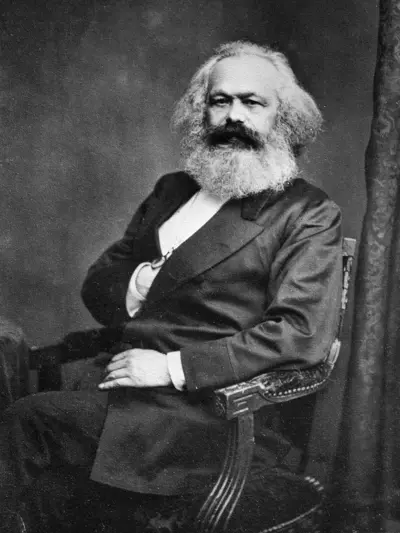
Karl Heinrich Marx was a German philosopher, economist, historian, sociologist, political theorist, journalist and socialist revolutionary. Born in Trier, Germany, Marx studied law and philosophy at university. He married Jenny von Westphalen in 1843. Due to his political publications, Marx became stateless and lived in exile with his wife and children in London for decades, where he continued to develop his thought in collaboration with German thinker Friedrich Engels and publish his writings, researching in the reading room of the British Museum. His best-known titles are the 1848 pamphlet The Communist Manifesto and the three-volume Das Kapital (1867–1883). Marx's political and philosophical thought had enormous influence on subsequent intellectual, economic and political history. His name has been used as an adjective, a noun, and a school of social theory.
