Lyndon B. Johnson Quotes
Harry Truman knows I am against him on this [civil rights] program. I just don’t think Congress should try to cram his program down the throats of Southern states.
Lyndon Baines Johnson, 1908-1973, 36th President of the United States (Democrat, TX), U.S. Congressman (Democrat, TX), Statement during his senatorial campaign, 1948, Quoted in Evans and Novak, Lyndon Baines Johnson
Sourced by: Eigen's Political and Historical Quotations


The statement was made even more dramatic as the outgoing Governor, Lester Mattox, standing behind Carter at the ceremony, was an arch segregationist.

This widely publicized statement by Mr. Ethridge was made when he was a member of the President's Committee on Fair Employment Practices during the hearings of this Committee at Birmingham, Alabama.


This was of course in addition to their moral position as taught by their religions.


It was used as a whipping boy and led to a re-alignment of Southern politicians to the Republican party.

He was right. Even the vaunted Southern Filibuster was broken by the strategy and tactics Johnson and Senator Humbert Humphry, the Floor Leader for the 1964 Civil Rights Bill.


Blacks were fighting and dying in WWII. They were equal when they were under fire, but otherwise not. The war was against fascist protagonists whose creed was inequality while the allies were upholding freedom and equality. But making that aspiration a reality was difficult.


Arkansas Governor Faubus ordered the national guard to prevent Black students from integrating Central High School in Little Rock. President Eisenhower was a man of action and not rhetoric and his lack of firm public statements overlooked an opportunity to use the Presidential “bully pulpit” and exercise his moral leadership and authority. Armstrong was irate at Eisenhower for appearing to do nothing and say nothing. See {615852}. When Eisenhower did enforce the court order and used Federal troops, Armstrong sent him this congratulatory telegram. His reference to walking into the schools was in support of many who suggested that the best thing the President could have done was to personally take one of the Black students by the hand and walk into the school with him or her. With the mood of the Southern racists, such an act was potentially very risky for the President and it is not known whether of not the President and his staff ever considered such an act.


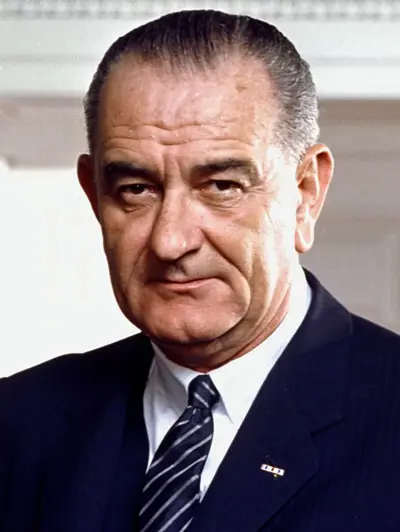
Lyndon Baines Johnson, often referred to by his initials LBJ, was the 36th president of the United States, in office from 1963 to 1969. He served as the 37th vice president from 1961 to 1963 and assumed the presidency following the assassination of President John F. Kennedy. A Democrat from Texas, Johnson was also a United States representative and later majority leader in the United States Senate. Johnson is one of only four people to have served, at various times, in all four federal elected positions.
