EMPRESS DOWAGER CIXI
(Empress Dowager T'zu-hsi | Cixi)
Japan and 7 Western countries had sent military troops to China ostensibly to protect “foreigners” who were the victims of the irrational violence of the Boxer Rebellion--{641726} and {641727}. The Chinese government was unwilling and/or unable to suppress the Boxers--{641838}. Regardless of the justification, this was an act of war—an invasion contrary to international law. The Chinese national forces were not only too weak to take on the Boxers but were no match for the 8 powers’ well equipped military forces. None-the-less, the Empress decided to fight. In the early fighting the Chinese Imperial forces killed the German Minister to China, Baron von Ketteler, thus precipitating full scale war.
The “Boxer Rebellion” was a very strong, populist, violent movement in China at the turn of the Century. The hostility was not directed against the Empress or the Government, but against the non-Chinese foreigners who were, theoretically and by treaty, under the protection of the Chinese Government. Cixi and the government had to decide to Crack Down on the Boxers, Support them, or remain passive. The movement was so strong and the government so weak, that is was not clear that the government could prevail in what would amount to a civil war. The Empress in effect vetoed the crackdown option on the grounds stated. With this quotation she made a fateful decision for China and the Foreigners and for her own legacy. She had been considered by Westerners one of the great rulers of the world of not of all time, and she was in many ways. But she made the wrong choice from the Western point of view; thousands of Westerners became casualties of the Boxer irrational xenophobic violence with the government doing little to stop it. Soon, she herself came to regret this policy decision--{641730}.
Indeed she did. In actuality, she was the ruler of the largest nation on Earth. However, she was not a very clever ruler and actually was responsible for keeping China very backward and weak because she was convinced that China was the most advanced of nations and very strong. Therefore nothing should be changed. Over 5 decades with no change is sure to make a nation backward, even if it started as advanced. See {620090}.
During her adult life, she was the de facto ruler of China. Officials then did little or nothing to curb the attacks on the various foreigners and foreign power that occupied and exercised some control over parts of China. The Government itself could do little as it was too weak militarily with many key officials bribed by the foreign powers. The Boxers were a grass roots xenophobic movement devoted to getting the foreign powers out of China by violence.
The Italians backed down and gave up their demand for territory, settling for a favorable trade treaty.
Every major Western power and Japan were looking to control parts of China for their own mercantile advantage. The Emperor, her adopted son, had stated that under no circumstances would the Chinese fight, but Cixi issued this decree, in effect, overruling the Emperor—a remarkable occurrence.
This absolute ruler concluded that single person judgment with advisors has not as sound as a system of open discussion and institutions affecting policy decisions and administration. She herself had made errors and admitted it—see {641730}.
She had read reports that Chinese faced in several lands of the West. The worst of these were Peru and Cuba where Chinese emigrant labor were kidnapped and worked in slave conditions. Prior to Cixi, Chinese Emperors had little or no concern for the laborers and peasants in their own country much less those Chinese who had gone abroad in search of a better life.
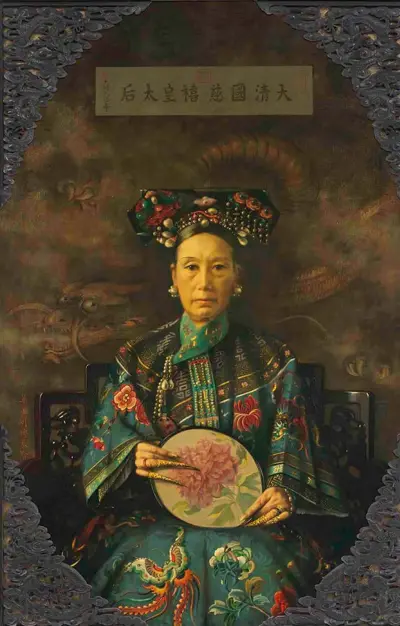
Empress Dowager Cixi was a Chinese empress dowager and regent who was the de facto supreme ruler of China in the late Qing dynasty for 47 years, from 1861 until her death in 1908. Of the Manchu Yehe Nara clan, she was elected as a concubine of the Xianfeng Emperor in her adolescence and gave birth to a son, Zaichun, in 1856. After the Xianfeng Emperor's death in 1861, the young boy became the Tongzhi Emperor, and she became the Empress Dowager. Cixi ousted a group of regents appointed by the late emperor and assumed regency, which she shared with Empress Dowager Ci'an. Cixi then consolidated control over the dynasty when she installed her nephew as the Guangxu Emperor at the death of the Tongzhi Emperor in 1875, contrary to the traditional rules of succession of the Qing dynasty that had ruled China since 1644.
