Spiro Agnew Quotes
You understand that, by making these records available to you I do not acknowledge that you or any grand jury have any right to records of the Vice President. Nor do I acknowledge the propriety of any grand jury investigations of possible wrongdoing on the part of the Vice President as long as he occupies that office. These are difficult constitutional questions which need not at this moment be confronted.
Spiro T. Agnew, 1818-1996, Vice President of the United States (Republican, MD), Letter to U. S. Attorney (Maryland) George Ball, August 14, 1972
Sourced by: Eigen's Political and Historical Quotations

The President had authorized the NSA to spy Americans who might have been suspected of being themselves or being in contact with terrorists without obtaining permission of a court including the Foreign Intelligence Surveillance Act (FISA) special court that had been established for these cases. Instead the administration argues that it was inherent in the powers of the Presidency in time of war.

See {635809} for an additional view on this act.

President Truman, acting as commander in chief, seized the steel mills to end a labor dispute that was curtailing critical production. The Supreme Court nullified the seizure.


The Senate was investigating a scandal where the George W. Bush White House had induced the Attorney General, Alberto Gonzalez, to fire 8 of their own political U. S. Attorney appointments because they had or were investigating/prosecuting Republican politicians for corruption or not prosecuting Democrats vigorously enough. Gonzalez took the responsibility for the firings but did “not remember” why each had been fired nor was there any record in the Justice Department indicating any shortcoming with their jobs. The White House political operatives refused to testify under oath citing “Executive Privilege.”


The United States government had for many years deposited all its funds in a single private bank, the Bank of the United States. President Jackson, without congressional authorization, ordered the Federal deposits to be distributed among state banks instead. The Senate passed a resolution demanding a copy of the "paper" he had read to the cabinet ordering the change of practice:

When the Senate was debating the Gulf of Tonkin Resolution, which would empower the President to take "all necessary measures" to repel any armed attack on U. S. forces, Senator Morse was one of only two Senators opposing the resolution:


Alberto Gonzalez, White House Counsel and later Attorney General who was forced to resign and David S. Addington, Counsel to the Vice President, had come up with a novel view of the powers of the presidency. They argued that since the President is the Commander in Chief, in a war situation or intelligence gathering thereto, has the Constitutional responsibility for that function, he need not obey any laws of Congress as in the conduct of the war Congress would be impinging on the Constitutional separation of powers which itself was prohibited by the Constitution. The argument did not find any significant legal support but for a while the George W. Bush White House behaved as if this were the law, despite the fact that even in the American Revolution and the War of 1812 Congress passed laws regulating the conduct of the armed forces as is provided for in other parts of the Constitution. Yet even Goldsmith would allow the President some powers that many think are unconstitutional and/or belong to Congress. See {32436}.


Hughes constantly allowed that it was improper for a sitting Supreme Court justice to be a candidate for the Presidency. But the Republican Party was badly split between the progressives and the conservatives. Each likely candidate had been on one side or the other, and was therefore unacceptable to the wing he had not supported. Hughes was one of the few Republicans who did not take sides in the 1912 schism as he was a member of the Supreme Court. His neutrality and his absence of any political statements in recent years made him a very attractive Presidential Nominee for Republicans. But his luster would wear off quickly if he let the Republicans know how he stood on any of the issues splitting the party. The only way that he could avoid saying anything was to maintain that he was not and should not be a candidate. Therefore he was nominated. However, to avoid losing one of the wings of his party, he had to essentially take a position on very few issues in the 1916 campaign. He just criticized President Woodrow Wilson and the Democrats. See {642634} for how the Wilson forces turned his avoidance of issues to their advantage.

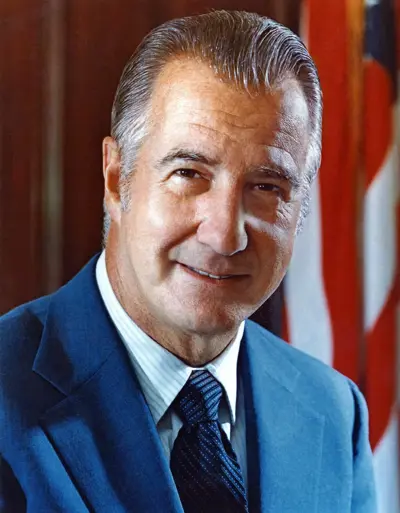
Spiro Theodore Agnew was the 39th vice president of the United States, serving from 1969 until his resignation in 1973. He is the second and most recent vice president to resign the position, the other being John C. Calhoun in 1832. Unlike Calhoun, Agnew resigned as a result of a scandal.
