Barney Frank Quotes
The President has a constitutional right to behave like a spoiled child.
Barney Frank, U.S. Congressman (Democrat, MA), House debate, August 3, 1989
Sourced by: Eigen's Political and Historical Quotations


Taken from the Nixon Tapes of June 14, 1971. This quotation illustrates the mental set of the Nixon White House where the President must be seen as infallible and obeyed without much questioning. After Nixon, that view did not surface again in American politics until the George W. Bush Presidency. The Federal Courts were not very sympathetic to the Haldeman assertion and allowed the publication.

Ashmun introduced this anti-war resolution during the Mexican War. This resolution failed, but Abraham Lincoln, then a Freshman Congressman voted for it

The United States government had for many years deposited all its funds in a single private bank, the Bank of the United States. In 1833, President Andrew Jackson, without any congressional authorization, ordered the federal deposits to be distributed among state banks instead. The Senate was furious and passed the first resolution of censure of a President in United States history:. Carried by a vote of 26 to 20. Four years later a pro-Jackson Senate majority voted to expunge the resolution.


President George W. Bush had ignored a federal law and tapped the phones of Americans without probable cause and a warrant issued by a court. The President’s defenders argued that the President, as Commander in Chief, has the Constitutional responsibility to lead the military and protect the nation. Intelligence gathering is part of military activity. Therefore the intelligence gathering is a Constitutional duty and the Congress, under the separation of powers doctrine, may not interfere with the President’s Constitutional Duty to conduct intelligence. Under this doctrine, the President need not obey laws that he believes impinge on his management of the war effort and the defense of the nation. Most legal scholars believe that this argument is nonsense, but the George W. Bush administration has stated the doctrine and it was the subject of much litigation.


This quotation has much more meaning that similar statements of dozens of other people who claimed Bush should be impeached. The reason is that Fine was a strong conservative wanting to impeach a conservative President and he was the person who drafted the articles of impeachment against President William Clinton which passed the House but Clinton was acquitted by the Senate. So Fine was generally seen as a partisan for Republican Conservatives like Bush and a man who acted strongly against Clinton, and yet he observed in this quotation that Bush’s crimes were more serious. See {583797} for a concurring view on impeachment of Bush.


During the Nixon administration FBI director J. Edgar Hoover was requested by White House operatives to cooperate with "the Houston Plan" of illegal surveillance of many Americans. Hoover refused arguing that it was too risky.


In England, the King was above the law. However, impeachment was a tool that could be used against his favorite ministers. In debating the United State Constitution one of the first questions to be determined was whether impeachment could be a tool used against the President or like, England, only the other government officials. Franklin urged the President be included. See also Mason: {584246}.


The Congress over the last century has ceded much of its Constitutional power to the President. Congress has much power to check the President, but just as Congress has not been very competent at legislating, oversight, and conducting hearings and investigations, it has not organized itself to use the powers it has very well.


This quotation was an attack on President George W. Bush who had argued to a nation hostile about the Iraq War that the decision on whether to continue the war should be determined in large part by the report that was to be given by the commander of our forces In Iraq, General David Petraeus. He reported that he thought we should give the situation some more time and effort, and that was the policy decision. Clark and others thought this was not fair to Petraeus whose job it was not to make the policy but to implement it. It was perhaps the only time in history where a President abdicated a major war policy decision to a field officer. The President even argued to Congress that they should all wait for the General to return to Washington. He argued that he made the decision; he just wanted to hear the General’s recommendation. Most believed that he could have obtained that without the General returning to Washington to talk to Congress and the American people.


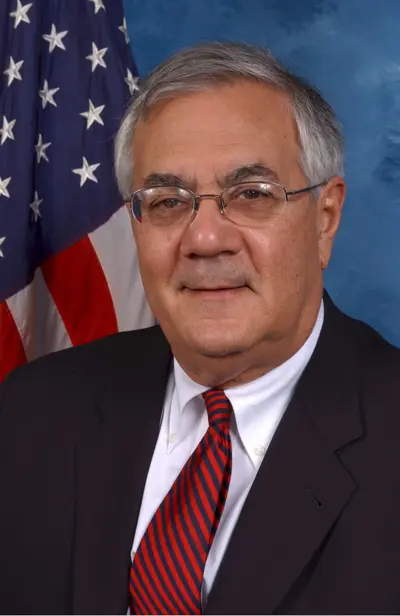
Barnett Frank is a former American politician. He served as a member of the U.S. House of Representatives from Massachusetts from 1981 to 2013. A Democrat, Frank served as chairman of the House Financial Services Committee from 2007 to 2011 and was a leading co-sponsor of the 2010 Dodd–Frank Act. Frank, a resident of Newton, Massachusetts, was considered the most prominent gay politician in the United States during his time in Congress.
