H. R. Haldeman Quotes
… the implicit infallibility of presidents, which has been an accepted thing in America, is badly hurt by this, because it shows that people do things the President wants to do even though it's wrong, and the President can be wrong.
Taken from the Nixon Tapes of June 14, 1971. This quotation illustrates the mental set of the Nixon White House where the President must be seen as infallible and obeyed without much questioning. After Nixon, that view did not surface again in American politics until the George W. Bush Presidency. The Federal Courts were not very sympathetic to the Haldeman assertion and allowed the publication.
H. R. Haldeman, 1926-1963, White House Chief of Staff (Richard M. Nixon), Explanation to President Richard M. Nixon of why the Pentagon Papers publication damaged the country, June 14, 1971
Sourced by: Eigen's Political and Historical Quotations


Actually, there are many in politics who to this day castigate Truman for his decision, but for Bloomberg’s generation and before, anyone would have pushed the button. And there are some who still fault Obama as technically, the U. S. had no right to violate Pakistani airspace and kill a resident of their state without any due process in the U. S. or Pakistan. Bloomberg would have easily pushed that button, but there are many officials who warned against it, and earlier Presidents—George W. Bush and Bill Clinton who did not authorize assassinations in foreign (allies) countries.

Trump, in contrast, to other president, in times of crisis, tendned to send tweets on the subject--often very political and divisive--instead of takeing the kind of leadership steps taht were taken by the otehr presidents of the 20th adn 21st century.


This quotation was an attack on President George W. Bush who had argued to a nation hostile about the Iraq War that the decision on whether to continue the war should be determined in large part by the report that was to be given by the commander of our forces In Iraq, General David Petraeus. He reported that he thought we should give the situation some more time and effort, and that was the policy decision. Clark and others thought this was not fair to Petraeus whose job it was not to make the policy but to implement it. It was perhaps the only time in history where a President abdicated a major war policy decision to a field officer. The President even argued to Congress that they should all wait for the General to return to Washington. He argued that he made the decision; he just wanted to hear the General’s recommendation. Most believed that he could have obtained that without the General returning to Washington to talk to Congress and the American people.


The Senator was blaming President Clinton for not stopping the attack on the U. S. Cole as he knew that there were hostile Islamic extremists who were known to have threatened to attack American assets wherever they were. His view was that given that President Clinton should have acted overtly and/or covertly to prevent the attack. This failure for him was an impeachable offence. He argued that George W. Bush was assuming the Presidency and this laxness and incompetence that lead to the death of 17 American sailors would end. And then came 9-11 with the same level of general information and some even more specific information and 3000 Americans were killed. However, unlike Lott, almost no one blamed President Bush’s lack of leadership for the attack on the Pentagon and the World Trade Center. Lott seemed to forget his standard of presidential performance and did not criticize or urge the impeachment of the President of his own party.


That is one view—the one tried the most frequently by Presidents who by their own estimates didn’t get a responsive civil service working to his priorities. Presidents like Teddy Roosevelt, Franklin Roosevelt, and Dwight Eisenhower and Lyndon Johnson had great cooperation from their civil servants; they instead appointed very competent people with strong senses of fairness and leading personnel. Ronald Regan tried both techniques. He used Wilson’s technique in his Education and Justice Department where there was slow-rolling and dissonance when his appointees tended to be ideologues with little or no outstanding professional competence in the fields they supervised. However, his military and State Department bureaucracies was very responsive to his appointees who were excellent leaders.

on the decision of whether to use military force against the Assad Syrian regime for their using chemical warfare against their own people

President Truman, acting as commander in chief, seized the steel mills to end a labor dispute that was curtailing critical production. The Supreme Court nullified the seizure.


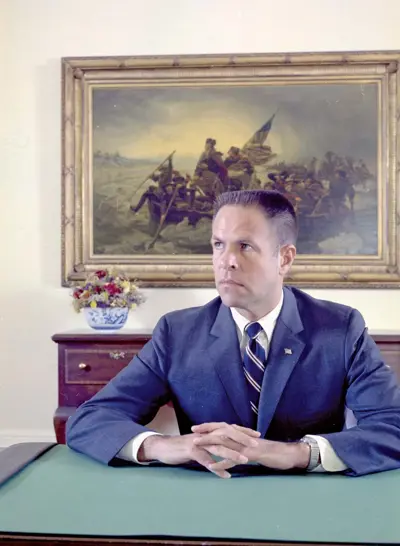
Harry Robbins "Bob" Haldeman was an American political aide and businessman, best known for his service as White House Chief of Staff to President Richard Nixon and his consequent involvement in the Watergate scandal.
