Wilhelm II, German Emperor Quotes
You English are mad, mad, mad as March hares. What has come over you that you are so completely given over to suspicions quite unworthy of a great nation? What more can I do than I have done? I declared with all the emphasis at my command… that my heart is set upon peace, and that it is one of my dearest wishes to live on the best of terms with England. …. To be forever misjudged, to have my repeated offers of friendship weighed and scrutinized with jealous, mistrustful eyes, taxes my patience severely. I have said time after time that I am a friend of England, and your press … bids the people of England refuse my proffered hand and insinuates that the other holds a dagger. How can I convince a nation against its will ?
As it turned out, the suspicions were correct.
Wilhelm II, 1859-1941, Emperor of Germany & King of Prussia, Interview, London Daily Telegraph, October 28, 1908
Sourced by: Eigen's Political and Historical Quotations


1st Earl Lloyd-George of Dwyfor. He was the Chancellor of the Exchequer at the time, but gave the English response to the Morocco crisis.

Bland was an expert in Asia and spent most of his time writing about Asian Politics. This quote shows that there was hostility and bad feeling between American and Japan long before WWII. This statement was written in 1921. The reality was that Japan was getting stronger as a militaristic expansionist nation which wanted to subjugate most of Asia. Ironically, they were using England and the European powers as models and sought to take Korea, Manchuria and much of Asia as Colonies, but this clashed with American values and even then there was animosity of the two systems.

The Prime Minister was visiting the United States and was staying at the White House. President Roosevelt had a spontaneous thought and wheeled himself into Churchill's room. The Prime Minister was stark naked, having just emerged from the bath. Roosevelt apologized but Churchill was unfazed and known for his nudity in his private quarters. He even used what might have been an awkward moment into an opportunity to make a political point.


This telegram was one of the more bizarre episodes leading up to WWII. The “solution” that Rothermore was praising was the German Army seizing and occupying a large part of Czechoslovakia – the Sudetenland -- in violation of the WWI Peace Treaty that Germany had signed. Further, Rothermere knew perfectly well that England and France were bound by treaty to come to the military aid of Czechoslovakia and war between Britain and Germany could break out at any moment. Yet he sent the telegram encouraging Hitler in his aggression. The Daily Mail, Rothermore’s very conservative newspaper supported English Fascist Oswald Mosley and wrote articles favorable to Mussolini and Hitler. There was a small but powerful part of English Aristocracy who were pro German and pro Fascist including the King, Edward, Duke of Windsor {584507} who was persuaded to abdicate and relegated to the Bahamas where his views were not so public. The Daily Mail catered to that part of the English Aristocracy.


The “proofs” were diplomatic assurances—treaties—that England would guarantee the territorial integrity of Belgium. The British made strong diplomatic efforts to persuade Germany not to occupy Belgium. The German’s none the less send armies in under the excuse that if they did not, the French would occupy the country and have a strategic advantage over them. Diplomacy could do no more good. England had to send troops or renege on its obligations. So England was in WWI.
Germany had demanded that Belgium allow German troops to cross Belgium to the French frontier. However, King Albert was concerned that this would be a de facto German occupation of Belgium and asked for help. The British tried diplomacy but things were out of anyone’s control and the First World War ensued.


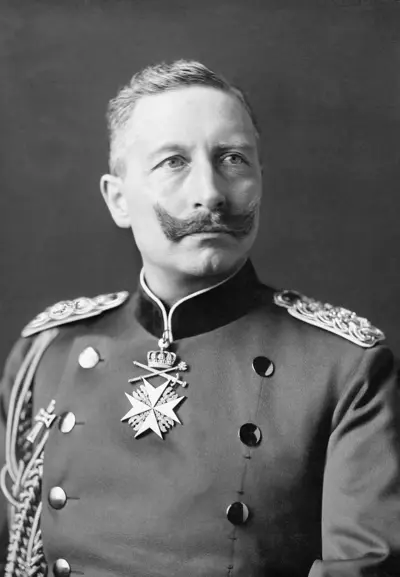
Wilhelm II, anglicised as William II, was the last German Emperor (Kaiser) and King of Prussia, reigning from 15 June 1888 until his abdication on 9 November 1918. Despite strengthening Germany's position as a great power by building a blue-water navy and promoting scientific innovation, his tactless public statements greatly antagonized the international community and his foreign policy was seen by many as one of the causes for the outbreak of World War I. When the German war effort collapsed after a series of crushing defeats on the Western Front in 1918, he was forced to abdicate, thereby bringing an end to the three-hundred-year rule of the House of Hohenzollern.
