Winston Churchill Quotes
England has been offered a choice between war and shame. She has chosen shame and will get war.


The Falkland Islands were very close to Argentina and far from England. The Argentineans had offered the few Islanders large sums of money to become part of Argentina, but this was rejected. Argentina was a military dictatorship with a terrible record of human rights abuses. The Falklanders preferred their traditional British style of government and affiliation. The Argentinean generals assumed that if they invaded, once they controlled the Falkland Islands, they could negotiate with the British over issues of sovereignty. They misinterpreted the American UN Delegate and concluded that America would not support Britain in a military response; they also assumed that while the British would complain in the UN, they would never go halfway around the world to invade the islands, now occupied and reinforced by Argentina. Thatcher would not negotiate unless the invaders left the islands. They did not do so voluntarily. The Argentinian military had been abusing their own citizens for so long that they had an inflated concept of their fighting ability. Britain freed the islands militarily, and Argentina was humiliated. The military government fell bringing democracy to Argentina—the only good that came out of the Faulklands War.


with Russia over the independence of Berlin and West Germany


The English were at War with Napoleon and Denmark was neutral. British leaders feared that Denmark might either ally themselves with Napoleon or provide him with ships from their well equipped fleet. The English decided on a preemptive attack on Denmark and Napier and other officers were ordered to Denmark. When they arrived, they were ordered to bombard Copenhagen and force the Danes to surrender. When this happened, the British seized the Danish ships and simply took them as war prizes. The issues of the morality and wisdom of preemptive attacks, as with the Americans in the Iraq war, was thoroughly debated but the government view prevailed to the shame of most Englishmen.

This appears to be the first American utterance of a longstanding doctrine of foreign policy.

Clinton was one of the leaders of the anti-war movement of the day. He even ran for President on the new “Peace Party.” New England, New York and many people in the Atlantic states thought the war of 1812 absurd. In reality, while the law was good for American morale and national pride, the casualties we suffered and the cost was far greater than what we were losing in our dispute with England. In actuality, France (under Napoleon) was offending America and seizing our shipping more than England. Note that Clinton was advocating negotiation even AFTER we would be attacked. This is in a way the complete opposite of the George W. Bush doctrine of preemption—attacking a hostile state BEFORE it has attacked us so as to prevent the casualties of an attack. The Bush doctrine was a great blunder in its only implementation—Iraq did NOT have the weapons of mass destruction that Bush and his administration claimed they had to justify the preemptive war.
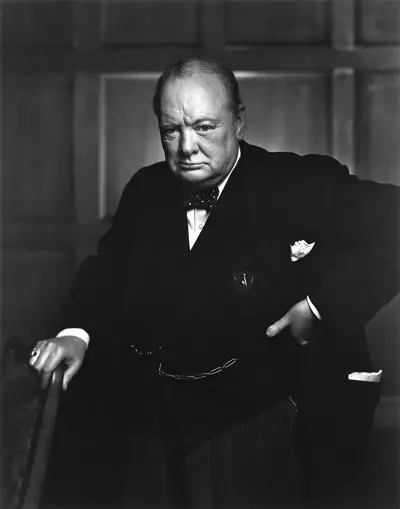
Sir Winston Leonard Spencer Churchill, KG, OM, CH, TD, DL, FRS, RA was the Prime Minister of the United Kingdom from 1940 to 1945, during the Second World War, and again from 1951 to 1955. Apart from two years between 1922 and 1924, Churchill was a Member of Parliament (MP) from 1900 to 1964 and represented a total of five constituencies. Ideologically an economic liberal and imperialist, he was for most of his career a member of the Conservative Party, as leader from 1940 to 1955. He was a member of the Liberal Party from 1904 to 1924. Churchill was also well known for his military career and as a historian, painter and writer, and among his many awards was the Nobel Prize in Literature.
