William Branch Giles Quotes
What concerns us most is the situation of the Judiciary as now organized … the Revolution is incomplete, as long as that strong fortress is in possession of the enemy; and it is surely a most singular circumstance that the public sentiment should have forced itself into the Legislative and Executive Department, and that the Judiciary should not only not acknowledge its influence, but should pride itself in resisting its will, under the misapplied idea of ‘independence’…. No remedy is competent to redress the evil system, but an absolute repeal of the whole Judiciary and terminating the present offices and creating a new system, defining the common law doctrine and restraining to the proper Constitutional extent the jurisdiction of the Courts
William Branch Giles, 1762-1830, U. S. Congressman and Senator (VA), Governor of Virginia, Quoted in Leonard D. White, The Federalists: A Study in Administrative History,1789-1801, 1948
Sourced by: Eigen's Political and Historical Quotations


Presidential dissatisfaction with the judiciary is an old and common problem.


The dramatic thing about this quotation is that in public, the mantra of conservatives about the courts of America is that they make and change laws as opposed to just interpreting and clarifying the laws. They traditionally accuse judges who rule against their favorite positions as using the courts as an instrument of political and social change. Here a leading conservative federal jurist, who thereafter became a member of the Supreme Court, was acknowledging and advocating the courts as instruments for conservative social, economic, and political change.


She was particularly critical of some of the current conservative politicians who were advocating retaliation against the judiciary because judicial decisions thwarted some of their fundamentalist preferences and preferred policies.


Later quoted by Alexander Hamilton in the Federalist Papers


There had been a revolution against the Qing Dynasty and an attempt to establish a republic. Wang, the spokesperson, quickly wrote an article in the Atlantic Monthly one of the most prestigious American publications. He minimized the degree of bloodshed, but by Chinese standards of civil unrest where over 20 million people had been killed in previous discords, this was relatively benign. It was a de facto military coup which also involved political assassinations which he carefully avoided mentioning, and just a few months after the publication of this article a second revolution broke out and this version of the Chinese Republic was very short lived.


Hatch was the chairman of the Senate Judiciary Committee at the time.

Surprising to many is the fact that the Federal Courts did not automatically get established when a new state joined the Union. Congress had to legally reorganize the Federal Court structure and appropriate additional money. In addition Senators then were elected by the State Legislatures who were not anxious to have any Federal Legal presence in their state if they could avoid it, as it might interfere with their State Court system. The Constitution provided for the Federal Courts but left it up to Congress to decide on all the details. It would not be until after the Civil War that the Federal Courts were very active in all States.
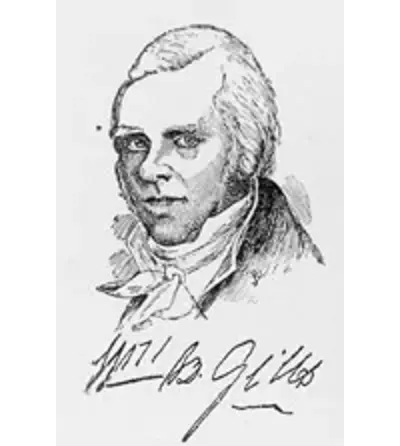
William Branch Giles was an American statesman, long-term Senator from Virginia, and the 24th Governor of Virginia. He served in the House of Representatives from 1790 to 1798 and again from 1801 to 1803; in between, he was a member of the Virginia House of Delegates, and was an Elector for Jefferson (and Aaron Burr) in 1800. He served as United States Senator from 1804 to 1815, and then served briefly in the House of Delegates again. After a time in private life, he joined the opposition to John Quincy Adams and Henry Clay, in 1824; he ran for the Senate again in 1825, and was defeated, but appointed Governor for 3 one-year terms in 1827; he was succeeded by John Floyd, in the year of his death.
