William Blackstone Quotes
In this distinct and separate existence of the judicial power in a peculiar body of men, nominated indeed, but not removable at pleasure, by the crown, consists one main preservative of the public liberty; which cannot subsist long in any state unless the administration of justice be in some degree separated from the legislative and also from the executive power. Where it is joined with the legislative, the life, liberty, and property of the subject would be in the hands of arbitrary judges, whose decisions would be regulated only by their own opinions, and not by any fundamental principles of law; which, though legislators may depart from, yet judges are bound to observe. Were it joined with the executive, this union might soon be an overbalance for the legislative. For which reason, by the statute 16 Car. I, c.10, which abolished the Court of Star Chamber, effectual care is taken to remove all judicial power out of the hands of the King's privy council, who, as then was evident from recent instances, might soon be inclined to pronounce that for law which was most agreeable to the prince or his officers. Nothing, therefore, is more to be avoided, in a free constitution, than uniting the provinces of a judge and a minister of state.
William Blackstone, 1723-1780, British Jurist, Commentaries on the Laws of England, 1783
Sourced by: Eigen's Political and Historical Quotations

This constitution was written 7 years before the national constitutional convention. It shows that there was concern about the separation of powers in United States even before the Constitution was drafted. See {616750} for an even clearer statement of the separation of powers principle.

The drafters of the Constitution were well aware of this view of Montesquieu’s which was one of the main bases of separation of powers and checks and balances in America.

Later quoted by Alexander Hamilton in the Federalist Papers


Hatch was the chairman of the Senate Judiciary Committee at the time.


One of the conundrums of our constitutional system is who has the last word as to what the Constitution means. Essentially it is the judicial branch headed by the Supreme Court. But there are those who believe that the current popular majority should have a say in what is or is not constitutional. If so the legislative branch should have the last word. Still others say that the President is the only person elected by ALL the people, so his opinion most reflects the will of the public. And then there are most who argue that the Constitutional system was created just to avoid the power of currently popular majorities, and the courts should decide based on the Constitution itself. So the statement has very little meaning except that Phillips thinks that the courts have too much power. Whoever gets to decide what is or is not Constitutional will be accused of being “over” the Constitution by those who don’t like the decisions. In our system, that is the courts.


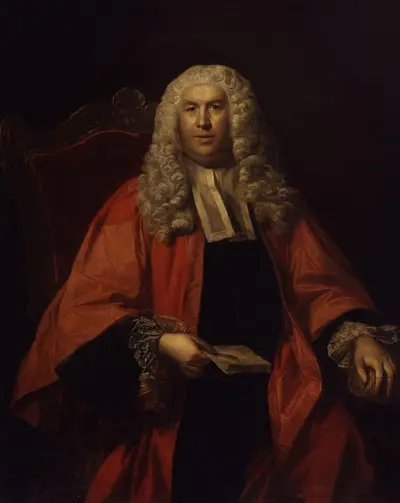
Sir William Blackstone SL KC was an English jurist, judge and Tory politician of the eighteenth century. He is most noted for writing the Commentaries on the Laws of England. Born into a middle-class family in London, Blackstone was educated at Charterhouse School before matriculating at Pembroke College, Oxford, in 1738. After switching to and completing a Bachelor of Civil Law degree, he was made a fellow of All Souls, Oxford, on 2 November 1743, admitted to Middle Temple, and called to the Bar there in 1746. Following a slow start to his career as a barrister, Blackstone became heavily involved in university administration, becoming accountant, treasurer and bursar on 28 November 1746 and Senior Bursar in 1750. Blackstone is considered responsible for completing the Codrington Library and Warton Building, and simplifying the complex accounting system used by the college. On 3 July 1753 he formally gave up his practice as a barrister and instead embarked on a series of lectures on English law, the first of their kind. These were massively successful, earning him a total of £453 (£71,000 in 2021 terms), and led to the publication of An Analysis of the Laws of England in 1756, which repeatedly sold out and was used to preface his later works.
