Ulysses S. Grant Quotes
We ... ought not to be rigidly bound by the rules laid down under circumstances so different for emergencies so utterly unanticipated.
Ulysses S. Grant, 1822-1885, 18th President of the United States (Republican, OH), Memoirs
Sourced by: Eigen's Political and Historical Quotations

He was referring to the legislative history of the Constitution.


the legal and regulatory system While this is generally true, the same very efficient private organziations sometimes act very efficiently against the interest of the public, or a part of the public in a discriminatory manner. There are other functions which for one reason or another no private organization chooses to take on, and we are left with government doing the best it can. And there are some areas where th cost of private service is just too high, and government assumes it for reasons of affordability. However sometimes there is a major problem created by competitive private organzaitions in such heated competition that the servie is terrible. In early America, Fire Fighting was assumed by private organzations, who would often fight with one another over who would handle the fire while entire neighborhoods burned down. The result was public fire service which is now the norm despite the fact that there might be better ervice in with a private company. America has attemted to balance this problem and tends to have done so better than most countries athough the issue is in contant debate in American politics.


Great crises like wars, frequently and great scientific and technical breakthroughs produce many situations that were never envisioned by the founding fathers when they drafted The Constitution. The Civil War had many of these.


This was the worst storm that hit the East Coast that anyone could remember. Despite the Governor’s shock, he and the other East Coast Governors together with the Federal and local governments performed magnificently keeping the fatalities very low considering the ferocity of the storm and the tens of millions of people affected.
Cleopatra was an outstanding ruler who spoke 9 languages and depended on relatively few advisors.


This quotation shows FDR doing something that politicians rarely do. The country was in the midst of the Great Depression and he was running for the Presidency against Herbert Hoover who as President would do little to help the destitute part of the population or improve the economy. Roosevelt did not lay out specific programs which he claimed would fix the problem. He himself really didn’t know for certain what would and what would not. However he promised bold experimentation—trying new things. When he was elected, he was able to fail with one program and just shift to another until enough were successful. But the great contrast was to Hoover who would do little.
Two of the 20th centuries greatest political leaders were Mao Tse-Tung and Franklin Delano Roosevelt. In most respects, these two were polar opposites. However, they had one characteristic in common. They were both willing to try things they were not certain of. If they succeeded, make it a part of the national program. If it failed, try something else. See Mao {642795}.

Technically, the probability has never changed. However, most probabilities are in relation to a specific event or time. A levee may have only a 1% probably of failing in a hurricane but if there are 10 hurricanes a year, the probability that the levee will fail at least once in 30 years is about 50%.


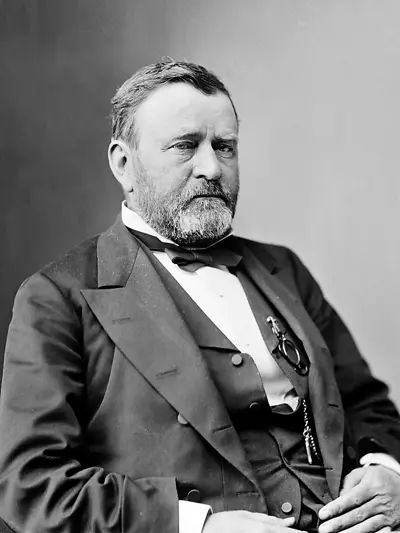
Ulysses S. Grant was an American military leader who served as the 18th president of the United States from 1869 to 1877. As president, Grant was an effective civil rights executive who created the Justice Department and worked with the Radical Republicans during Reconstruction to protect African Americans. As Commanding General, he led the Union Army to victory in the American Civil War in 1865 and thereafter briefly served as Secretary of War.
