Rached Ghannouchi Quotes
We have continuously defended the right of women and men to choose their own lifestyles, and we are against the imposition of the headscarf in the name of Islam.
In a country like Saudi Arabia, such a statement would be very radical. However, before the Arab Spring in Tunisia, that country was much more modern than most Arab nations and headscarfs were not required nor was there much social pressure for them except in the rural areas. So this was a status quo statement opposing the Islamic Parties which advocated mandatory traditional dress for women.
Rached Ghannouchi, Leader of the Tunisian Al Nahda Party, Quoted in Foreign Policy Magazine, December 2011
Sourced by: Eigen's Political and Historical Quotations

This was a very unusual statement for a major party, established, politician to make in a Muslim Arab nation where sexism is not only culturally entrenched, but strongly religiously enforced.]


This statement is referring to the custom of women covering their eyes whenever a man who they did not know passed them. Turks did not ever use Burkas the way some other Muslim countries do, but they wore headscarves and covered their eyes when a strange man appeared. This was a shocking statement in a sexist Islamic culture. Although the process of modernization and reform in Turkey was relatively bloodless, Ataturk was prepared to and did use force to defend it. This and many others made the role of women not only uniquely equal in the Islamic world, but women were suddenly elevated to the level of most Western nations and in voting rights were ahead of most. He used his own family to set an example. See {584503}.


An immigrant Muslim woman herself, she was very familiar with the physical abuse of a woman in a Muslim household where she may not be the only wife and Islamic law and tradition makes her subservient to the man and allows her to be beaten by him.
This was another historical reality that shocked traditionalists. There was nothing in the Koran or Islamic scripture requiring women to wear veils and burkas. Many Muslims and non-Muslims, to this day, do not realize that.
Some Muslim women in Holland are virtual prisoners of their husbands and families. Many are beaten in conformity with a fundamentalist interpretation of the Koran. Some are even killed. Under previous concepts of Dutch tolerance and respect for pluralism the Muslims in Holland were not interfered with. However, due to her efforts, the rights of the women are now taking a higher priority and are not being subjugated to tolerance of Islam generally.


She was referring to Malala, a young Pakistani girl who was shot and badly wounded in an assassination attempt. She had publicly advocated girls attendance at school—a practice banned by the ultra-fundamentalist Taliban.
The burqa wearing practice was outlawed by French Law.

This quotation which appears absurd on the surface given Iran’s terrible record with religious minorities provides insight to Islamic orthodox thought. For the orthodox Muslim, Sharia—Koranic Law—is the basis of the society. God defines the rights of people and their obligations. Whatever rights are provided by Sharia, Khomeini and some others wished to provide them equally to religious minorities also. However, those rights do not include the right to criticize the Islamic law or the leaders who implement it. That would be heresy if done by a Muslim, a Christian, or a Jew. A Christian church may not erect a public cross or ring bells on Sunday. That is prohibited by the Koran and is imposed on all. Bahai religious adherents are tracked down in the Islamic Republic and are often executed. ‘What about their rights?’ they ask. The answer is that the Bahai were Muslims who have become “backsliders” and heretics, and under Sharia, they must be executed for heresy; they are deemed to be heretical Muslims and not members of a minority religion.
This proverb is a large part of the conceptual basis of the concept of honor killing. It starts with the notion that women are property. However, being animate property women are in the same class as livestock. And if a camel or a donkey get lose and does damage, the owner is responsible. So if a woman does something wrong, it is the father or the husband who is responsible. Since sexual behavior of most kinds is contrary to the Islamic custom and law, any activity in this regard, demonstrates that the father of husband has not been up to his obligations and is therefore dishonored. Therefore, the least he can do, to provide a deterrent to other women is to kill the offending female. Without the concept of property, the entire chain of logic collapses under its own weight.

Said was commenting on the furor that developed in 1989 when Iran Ayatollah Khomeini issued a Muslim legal opinion—a fatwa--calling for the death of, and offered a bounty on, Salman Rushdie whose book, Satanic Verses, contained material to which they objected as blasphemy:

Jinnah was a modern Islamic reformer as this quotation demonstrates. Pakistan is not as backward as most of the Arab Islamic countries on the role of women. There are many Pakistani businesswomen and professionals. Pakistan has even had a female president. However, the fundamentalist Islamic forces that dominate the culture constantly preach and advocate the literal interpretation and following of Sharia which calls for a traditional, subservient traditional role for women; “honor killings” are common; “a rapist cannot be convicted on a female victims testimony; there are calls for the killing of adulteresses and other primitive throwbacks. Jinnah’s vision has not come to pass yet.


France is a nation that welcomes immigrants provided that they assimilate to French culture, language and customs. In contrast, the United States does not require much assimilation and has had much more success in absorbing many immigrants.

This is a particularly interesting passage of the Koran. On the one hand it provides the religious justification for the sexist dominance of the male in a marriage. However, at the same time, it gave wives rights at a time when few cultures and religions did--such as the right to own and inherit property. Women in the Western world did not obtain some of these rights until the last hundred years. So historically, Islam was somewhat ahead of Christianity when Muhammed lived, but while most Western interpretations of gender role and rights have changed and advanced, a small minority of Islam has been reformist and modern so Islam has gone from a leader in modern gender relations to an obstacle to equality and fairness by not changing and reforming.
Islam is no more monolithic than any of the other major religions. This view is not held by most Muslim Coutnries or Islamic leaders throughout the world. It is held by a significant minority however.

This type of religious sexism is not unique to Islam. Fundamentalist Christians place women in a secondary role as do fundamentalist orthodox Jews although both allow a man to take only one wife. The Islamic scripture tells us that the Prophet allowed multiple wives only if the man had the resources to care for the wives and all the children. 4 is the maximum.

At the time she made this statement, she was the French Minister of Families, Infants and Women;s Rights. France was in the midst of a political and legal argument over the right of communities to ban women at the beaches to wear burkina’s. These were garments that covered the woman’s body completely that some French Muslim leaders claimed was the only mortal way a Muslim woman could go to a beach. Secularists divided into two groups. Those who argued that the right of dress or undress for a French woman was inviolable by the state. The otters groups argued that the burkini was clear method of control of women by men which is so contrary to French rights and mores, that the community should be allowed to be practiced. The Minister was with the latter group.

One of the interesting similarities between Islam and Judaism is that there is no intermediary between a person and God. There is no hierarchy of validity of interpretation other than what culturally people tend to want to respect clerics. Different cultural subgroups respect different clerical leaders and in many cases, no leaders at all. The latter is the majority in Judaism but still the minority among Muslims, The Baroness is one of the Islamic Reformers who gives little or no credence or respect to intermediaries especially males.

First female presidential candidate & first divorcee to run for that office. The half to which she was referring were the females, who by many narrow laws were unable to participate in the intellectual and political life of the country. At the time, women could not even vote.
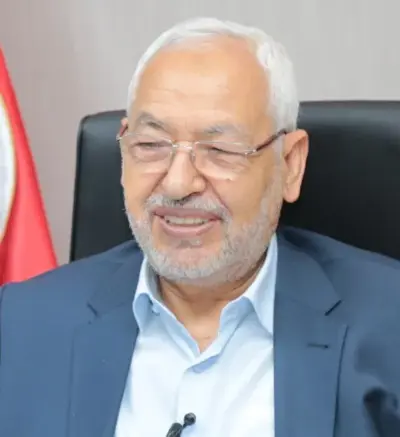
Rached Ghannouchi, also spelled Rachid al-Ghannouchi or Rached el-Ghannouchi, is a Tunisian politician and thinker, co-founder of the Ennahdha Party and serving as its "intellectual leader". He was born Rashad Khriji (راشد الخريجي).
