Ida B. Wells Quotes
The year of 1901 with its lynching record is a thing of the past. There were 135 human beings that met death at the hands of mobs during this year. Not only is the list larger than for four years past, but the barbarism of this lawlessness is on the increase. Six human beings were burned alive between January 1st 1901 and January 1st 1902. More persons met death in this horrible manner the past twelve months than in three years before and in proportion as the number roasted alive increases, in the same proportion has there been an indifference manifested by the public. Time was when the country resounded with denunciation and the horror of burning a human being by so called Christian and civilized people. The newspapers were full of it. The last time a human being was made fuel for flames it was scarcely noticed in the papers editorially. And the chairman of your bureau finds it harder every year to get such matter printed. In other words, the need for agitation and publication of facts is greater than ever, while the avenues through which to make such publications have decreased.
Wells, more than any individual in American history, documented and publicized the horrid practice of lynching in the belief that if the American people knew the horrors of what was going on, they would put a stop to it. She was right in the long run but it took more than 50 more years before the last vestiges of this form of racial torture and murder was ended in the South. The morality of the South was so warped that the torture, burning and killing was entertainment—viewed by many townspeople including women and children. The leading citizens of the South refused to investigate and prosecute those who actually performed the lynching even though there were photographs and hundreds of eye witnesses and newspapers carried the horrible stories.
Ida B. Wells, 1862-1931, Educator, Journalist, & Co-founder, NAACP, 1902
Sourced by: Eigen's Political and Historical Quotations

The “remarks” were complaints to the legal authorities that her husband had been just lynched. The language of AP describing the event of the late 19th century was all the more remarkable since Ms. Turner was 8 months pregnant. She was hung upside down, and while still alive her belly was slit open. When the baby fell out and started to cry, one of the Valdosta citizens crushed its head with his boot heel. Then they doused her with gasoline and burned her alive. The mob then fired hundreds of shots into Turner's body. This quotation shows how even the national Associated Press syndicate felt it had to report a lynching, torture, infanticide amd murder without any moral or ethical commentary as if they were reporting a drought or an auto accident. The domination of Jim Crowe attitudes in the South and even parts of the North surpressed serious journalism regarding lynchings until Ida Wells {624106} made the breakthrough.


Wilson, a history and government professor and college president before politics, was has been accused of being one of the most racist Presidents since Reconstruction. Prior to his Presidency, the Federal Government had been making steady progress in hiring African Americans. Under Wilson there was a wholesale firing of a large proportion of them. Some apologists argue that his League of Nations and other major aspirations required the votes and cooperation of Southern Senators who insisted that many of the blacks be terminated. At the same time, the KKK was near the zenith of its membership and political power and was an intimidating force. Wilson’s home state of New Jersey not only had a large KKK membership but there were lynching of Blacks in his own state and when Governor and President he never asked for any anti-lynching legislation.

For years through the Jim Crow years, Whites murdered many Blacks with impunity if they were perceived to be uppity or to try and obtain their Constitutionally Protected rights. Most took place in the South. The Negroes were typically tortured, mutilated, burned and hung from trees where they would be left for days as the major purpose was to strike terror in the Southern Black population. The Southern State and local governments never opposed the policy via oratory, legislation of law enforcement. The Federal Government did not interfere either. And much of the FBI under J. Edgar Hoover actually enabled the White Citizen’s Councils and the Klu Klux Klan. The NAACP began an anti-lynching campaign and Ms. Holiday was a one-woman public exposure campaign centered around this song. The anthem itself was written by a New York City schoolteacher named Abel Meeropol, using the pen name, Lewis Allan. It reached millions of Americans and Holiday fans the world over. To view some of the historical scenes described in the song, see http://withoutsanctuary.org/main.html

This statement was published in a major magazine of the time. It referred to a notorious lynching in the South where the victim had been brutally tortured and burned to death. In this case the victim had apparently committed a horrible crime. The Bishop condemned the horrific nature or the lynching but took the view that it was an act of insanity and that the relatives of the child killed by the lynching victim may well have been driven to insanity by the act However, this lynching, like most all in the South was not just an act of vengeance—insane or not—by relatives of a victim, it was participated on by a large mob, many of whom had no relationship to any of the parties. Whites who committed horrible crimes were rarely lynched, but many accused Blacks were lynched even though they turned out to have been innocent.

Incredible as it seems today, no Black person had ever dined in the White House as a guest of the President. African American servants were common. And Abraham Lincoln had received many Black visitors as had Presidents after him. But no president had ever had a Black person to dine as a social equal. The photo, reproduced here, illustrates the parity. But that was the worst thing a President could do so far as Tillman and his fellow racists were concerned. They had, since the end of the Civil war, used violence and terrorism to murder, maim and/or intimidate the Negro population to remain in an economic and socially inferior position. In Tillman’s state over these decades they had more lynchings than legal executions and there were plenty of them. Newspapers over the South riled up the whites and there was a wave of terror to be sure that the President’s importune action would not be taken as an endorsement of the Negro’s right to any equality or even dignity. This dinner essentially wedded all the Blacks to the Republican Party and all the Southern Whites to the Democratic Party. This would remain the political situation for over 60 years until the Democrats passed the LBJ Civil Rights Act in 1964 and the Republicans decided to solicit the Southern White racists who accepted the invitation and within a few years, there was a complete reversal of party loyalty of most Blacks and most Southern White Racists.
This quotation illustrates how the racist South defeated the objectives of the Civil War and Reconstruction by the institution of Jim Crowe laws and so called “states’ rights”. It would take more than another half century for the Yankees and the vast majority of the non-Southern Americans decided that the Southerners could no longer “do as they pleased” with fellow human beings. It is hard to believe for us today that an entire section of our country could actually believe in the morality of the South but that is the tragic history of race relations in America.
Buying furniture and equipment for Negro schools was perceived by the White Population as “squandering public funds”. Web returned with the Militia but no one would testify against the Klan. Huggins left the area and went to the North. The Klan did not kill him, but they accomplished their objective of intimidating all the local people Black and White so that Negro schools would not be furnished and getting rid of the only White who tried to improve Negro schools. The methods of terrorists have not changed much since then.


This statement was made long after slavery had been abolished and Jim Crow was on the rise in the South.

Blacks were not allowed to testify in court in the Southern States. The reasons why has never been clear. Many slave keeping societies like Ancient Rome not only allowed slaves to testify in the courts, but required them to do so in many circumstances even when their owners were opposed.

This is one of many instances where Black leaders advocated armed self-defense. In the early 20th century, this worried whites who often accused these blacks of advocating violence against whites. It also made non-violent, anti-gun, blacks, like Booker T. Washington, more popular.


the white Southern racist system She was one of the first prominent white southerners to denounce racial segregation.

He was not only an atheist himself, but he was a major opponent of organized religion which he regarded as one or the major initiators and drivers of slavery, segregation and discrimination. For this reason he was critical of Martin Luther King—{583307}. His irreligiosity had always prevented his gaining much support from his fellow African Americans even though a great writer like H. L. Menken considered Schuyler, "the best writer in America".

Named after penal reformer Johne Howard, 1726-1790. Howard Associations have since been organized in many countries.

In 1831 a slave preacher, Nat Turner, led a rebellion in North Carolina killing over 50 whites. Even though Turner and the rebels were captured and executed, whites throughout the South, took vengeance on any slaves they could find. This description was of a North Carolina community.


Louis Farrakhan was an anti-Semitic and Black Racist.


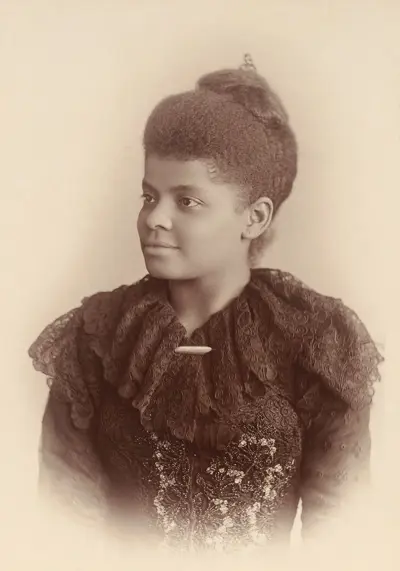
- Born: July 16, 1862
- Died: March 25, 1931
- Nationality: American
- Profession: Journalist, Civil Rights Women's Rights Activist, Teacher
Ida Bell Wells-Barnett was an American investigative journalist, educator, and early leader in the civil rights movement. She was one of the founders of the National Association for the Advancement of Colored People (NAACP). Over the course of a lifetime dedicated to combating prejudice and violence, and the fight for African-American equality, especially that of women, Wells arguably became the most famous Black woman in America.
