Jimmy Carter Quotes
The root of the problem [secrecy in government] is not so much that our people have lost confidence in government, but that government has demonstrated time and again its lack of confidence in the people.
Jimmy Carter, 39th President of the United States (Democrat, GA), December, 1974
Sourced by: Eigen's Political and Historical Quotations


Senator Dianne Feinstein, Chairman of the Senate Intelligence Committee, had released an unclassified Summary of the Committee Report on the CIA using torture and perverse treatment of suspect terrorists in the aftermath of the 9-11 attack on New York. Most Republicans argued vehemently that the Report should be classified and kept secret as the CIA behavior was so egregious, unpalatable, and morally reprehensible that there would be negative consequences including perhaps demonstrations and attacks against Americans in foreign countries. Moreover, Terrorist organizations would use the heinous CIA behavior as a recruiting tool for anti-American terrorists. McCain, who had himself been the victim of North Vietnamese torture cited the moral and ethical reasons to prohibit torture but also explained what has been proven over and over again that torture victims will tell the torturer any nonsense that they think the torturer might believe just to get obtain relief from the agony of the torture.


The improved access comes from the rapid technological and economic development of open source information available to the public. Governments will also benefit although governments will not be able to maintain as much secrecy,

There were many critics who were concerned that the ITU was trying to regulate the Internet, but no one could be sure as the proceedings and meetings of the ITU are not publicly available. This is a classic UN problem. They see themselves as representing governments and not people. The Governments have the information and so they delude themselves into believing that they are transparent, when the reality is that for the individual they are totally opaque. Most critics who worry about UN regulation of the Internet, are just as concerned with what other countries are proposing than what there own government’s position is. And most governments themselves do not release the actual transcripts or proceedings of the ITC meetings but only documents giving their positions. This is an example of secrecy being promoted as transparency where the UN covers for member nations who want to maintain secrecy.


_0_thumbnail_47x47.jpg "Statue of Robert Hall in Leicester.")
For many people the implication of this quotation is that there should be no government secrets withheld from the citizens who have the right to examine. Others argue that government may have temporary secrets to protect against foreign enemies for example, but that these must be declassified very promptly so that the citizens can examine the actions of their government in time to replace the government if they are not satisfied. Almost all government officials tend to reject the first implication out of hand, and grudgingly accept the second with their discretion controlling when declassification should take place. The problem of America is twofold. There is much over-classification (material kept secret that should not be at all), and the time till declassification is long in general and truly absurd in many cases. For example, there are documents from WWII that by 2013 had still not been declassified. See {591444}, {641317}, and {589105} for exemplar views. William Jennings Bryan introduced this principle into the American political dialogue. See {641027}.


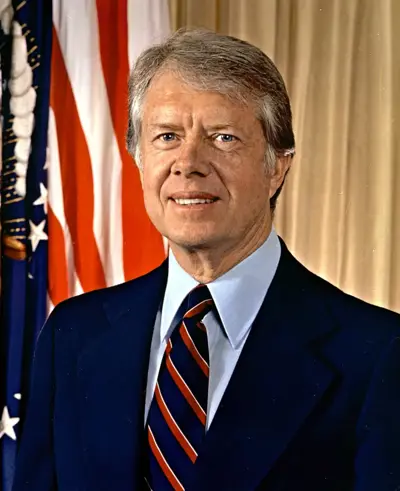
James Earl Carter Jr. is an American politician, businessman, and philanthropist who served as the 39th president of the United States from 1977 to 1981. A member of the Democratic Party, he previously served as a Georgia State Senator from 1963 to 1967 and as the 76th governor of Georgia from 1971 to 1975. Since leaving the presidency, Carter has remained engaged in political and social projects as a private citizen. In 2002, he was awarded the Nobel Peace Prize for his work in co-founding the Carter Center.
