Calvin Coolidge Quotes
The national laws and the laws of most of the States regulate the sale of narcotic drugs.... Their use is, in part, perhaps, due to physical disease, and, in part, to lack of moral stamina, but their abuse is almost wholly a result of violations of the law. If the law can be enforced, medical science would very soon rid the country of this menace
Calvin Coolidge, 1872-1933, 30th President of the United States (Republican, MA), October 1923
Sourced by: Eigen's Political and Historical Quotations

With this type of rhetoric (see Quotation 643709) for another example), he gave the green light to local law enforcement agencies and vigilante groups, who in the first few weeks of his term of office, murdered without trial or any due process 1500 assumed drug dealers and drug users. In some cases feuds and scores were settled by the false accusation of a rival or enemy, and since there was no trial or way for the accused to even try and prove he was not a drug addict of dealer, a number of totally innocent people were victims of extra judicial killings encouraged by the President of the Country.


An Aborigine herself, she had co-authored a major study of 45 aboriginal communities of Australia’s vast Northern Territory—the alcohol abuse was so great that young pre teen girls were trading sex for alcohol, parents in large numbers were too drunk to care for children. Few children attended school. Many were physically abused. The Government responded by attempting to ban alcohol in the aboriginal communities and withholding government welfare payments from parents who would not send their children to school. At the time there were 470,000 aborigines in Australia’s 20 million population.

This method of substance abuse prevention represents what scientists now call “environmental prevention” where instead of dealing with individual alcoholics the environment is altered to reduce the likelihood of developing fewer alcohol-related problems. Almost every state uses Locke’s principle and regulates the number of liquor outlets in any most areas. Those communities which have a very high density of bars and liquor stores tend to have more alcohol-related violence. The riots of the Watts area of Los Angeles in the late 20th century took place in one of the highest densities of liguor stores in the country.

It is not clear that Wright actually used these words of the first title or the editors created it. The substance is his and the second line is definitely his. At the time, the average American mistakenly thought that China had a much higher consumption rate.

He was the first Chinese official to make opium illegal. However, British many merchants were involved in a complicated trade scheme whereby they brought opium to Canton. They paid not attention to the new laws against opium the same as their Chinese customers. Lin Zexu, perceiving Queen Victoria to have powers equivalent to the Chinese Emperor who could do anything in China, He assumed that the Queen could and would control the merchant’s behavior, and before punishing the British merchants, he was putting the Queen on notice. There is no record of what Victoria did, if anything. When Lin Zexu tried to enforce his ban on opium, the British Merchants resisted and the First Opium War broke out between China and Britainin which the Chinese were humiliated and resent to this day. A bronze statue of Lin Zexu was erected in his honor in Chatham Square (Kimlau Square) of New York City's Chinatown.


Cixi had issued a 10 point edict designed to end opium use in China. One of its most interesting elements was that it only applied to Chinese under the age of 60. She recognized that for those elderly people who are thoroughly addicted to opium, prohibition would be to radical a change and their life expectancy was not very long. At the time, the average lifespan of Chinese was under 50.
British merchants and the East India Company made huge profits from the drug trade buying opium in India and selling it to China where it had become immensely popular. But when the Chinese (led by Lin Zexu) tried to ban the import of opium, the British fought two wars with China to force the reopening of the opium trade. At the end of the 20th century, some referred to England and the English Crown as the largest Drug Cartel in history.


The reason that this is a noteworthy quotation is that it illustrates a problem of alcohol and other drug prevention. Specifically, the “fact” that is the message of the billboard is not correct and exaggerates the danger. The general problem is well-intentioned but inaccurate and misleading information provided to the public. When the public, especially young people, discover that the government or the other organization urging the public to eschew drugs is not telling the truth, they not only tend of disbelieve all anti-drug messages and believe that the warnings given are just part of politics or prudish elements of the society. In this case, many young people and adults have seen or know people who were heroin addicts and are no longer. They are not hooked for life. Worse, a single dosage of heroin does not per se inevitably cause addiction. There have been people who used heroin once, continued to use and became addicts. But there are many more who have tried heroin once or twice who did not become addicted. The real risk is that if someone tries heroin once, he/she may become one of those who goes on and gets hooked. The billboard message is “WILL” and the truth is “MAY”.

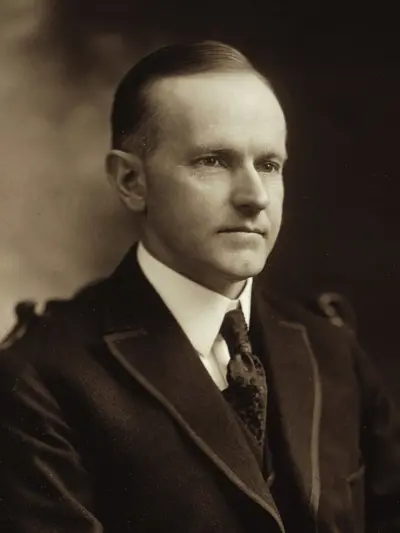
Calvin Coolidge was an American lawyer and politician who served as the 30th president of the United States from 1923 to 1929. A Republican lawyer from New England, born in Vermont, Coolidge worked his way up the ladder of Massachusetts state politics, eventually becoming governor of Massachusetts. His response to the Boston Police Strike of 1919 thrust him into the national spotlight and gave him a reputation as a man of decisive action. The next year, he was elected the 29th vice president of the United States, and he succeeded to the presidency upon the sudden death of Warren G. Harding in 1923. Elected in his own right in 1924, he gained a reputation as a small-government conservative and also as a man who said very little and had a rather dry sense of humor.
