Mormons Quotes
The Kirtland Safety Society Anti-Banking Company will pay on demand to bearer Three Dollars.
In the 1830's paper money was issued by many public and private agencies. The Mormons, among others, didn't trust the banking system or the Bank Notes of the time. They formed their own organizations and issued Anti_Bank Notes.
Mormons, $3 Anti-Bank Note, 1837
Sourced by: Eigen's Political and Historical Quotations

At the time there was no national paper money. Individual banks printed their own and paper money was not accepted or heavily discounted most Americans. Most opposed a tender law that required paper money to be accepted in commerce.

He was against paper money. At the time, any bank could issue its own paper money or “banknotes”. However other banks would not redeem the banknotes for the full amount; they would “discount” the note. Usually, the further away the bank was from the original bank, the more discount they took. Interstate commerce was almost impossible. Alexander Hamilton, Jefferson’s nemesis, had a much more modern point of view and fortunately his view prevailed. Paper money could only work if it was issued by a central bank with no discounting by other banks. The paper money had to be “legal tender”.


At the time, a bank note—paper money issued be a private bank—was not backed by any gold or silver and was not insured bym the government. A bank could print as much as they wanted, so it was always worth less as the further you were from the particular issuing bank, the less you could get your bank note, because no one knew whether or not the issuing bank would redeem the note or even be in existence. So every private bank note had diminished value for the public. However, carrying gold and silver around and making change for precious metals was difficult and often impractical. So people used banknotes. The same thing happens with credit cards today. The merchant has to pay a fee to the credit card company and the bank and therefore charges us more for whatever we buy. But most consumers and merchants are willing to pay the difference to obtain the convenience of the credit card,

During the Civil War, the U. S. Government printed paper money (specie) for the first time. 20 years afterward, the paper money was still controversial.

At the time any private bank could issue their own money. Private sector bankers thought it outrageous that the Congress should consider trampling on their rights to issue money. The solution that was finally adopted some years later was to use the Federal Reserve Board to control the money supply. It is independent of the Congress and the President but members are appointed by the President and confirmed by the Senate. Our system, like no other system, is a compromise where neither the Government or the Private Sector controls the American money supply.


Three years after he wrote this essay, the U. S. Economy suffered the Meltdown of 2008 and the Great Recession where the major American banks had much too small capital bases to survive so the Federal Reserve and the taxpayer bailed the banks out. Much of the problem was if a consumer or a business borrows money from a bank, he/she must have a capital base at least equal to the amount borrowed. But under the modern American banking system, if a bank wants to borrow from the people, the bank doesn’t even have to have a capital base of as much as ten percent of what it borrows and often has considerably less.

Much of the South during the Civil War lived in a fantasy universe where all the reality would not impinge upon them. Eggleston was an accomplished writer who had served in the Confederate army of the Civil War. 20 year after the war he wrote a series of articles for the prestigious Northern Atlantic Monthly trying to convey the war from the Southerner’s point of view. The South just kept printing money to take care of their perceived war and civilian needs without regard to the value of the money they were printing. Even in the 21st century collectors had a great deal of Confederate paper money, that had value only as a historical curiosity.
The same argument can be made against the modern paper money supply. What Jefferson and most of the founding fathers, with the exception of Alexander Hamilton. did not realize was that the major stability of any kind of money was not only the silver or gold that backed it but the political and legal stability of the nation and the size of its productive economy. Where Jefferson was right however is that all these banknotes at the time were issued by local private banks. The Government had no responsibility for paper money and had no knowledge of how much paper money any bank issues and whether or not they had any silver to back it up. Banks didn’t trust other bank’s notes and would only redeem them at a discount. A $10 note from a South Carolina bank might only be worth $7 in New York and $6 in Boston. The early American monetary system was a mess.

The alternative would have been for the colonies to borrow English money at high interest rates and use that. Or use money from private banks (which occurred later.) Many conservatives are today a little shocked that some of the American Colonies just printed money with no backing but it worked—at least at the local level. A Boston Bank for example, would take a large commission for a Bostonian to convert Pennsylvania money into Massachusetts money. So it was not a very good system for trade between colonies and International trade. But English money was used for that. The colonists pragmatically got the “best of both worlds” and paid as little interest as they needed to. This system is essentially what we use today on a national scale with no gold or silver backing of the money.

At the time, there was no United States currency. Private banks in some of the states issued their own money. A dollar from Georgia might only be worth 75 cents in New York.

This is a remarkable quotation in that it proposed exactly what the United States did in the Nixon administration. We went off the gold standard and backed American money with the wealth and “full faith and credit” of the nation and all its assets. It has been the strongest and most sought after currency in the world despite the fact that it is not backed by gold or silver as earlier American currency was.


What Franklin Delano Roosevelt began, President Nixon would in 1971 complete by removing America from the gold standard entirely and ending fixed rates of exchange. There have been those in government who did not understand the modern economics of money and who believed that currency had to have a fixed rate of exchange for gold or silver otherwise it was worthless. Roosevelt had to deal with them as did Nixon later. Even into the 21st century when it had been amply demonstrated that the best currency in the world was the United States dollar precisely because it was backed up by the full faith and credit of the United States Government, there were those who complain that United States money is not sound currency and argue for the return of the gold standard.


Attempting to defend charges that his bank and others were engaged in monopolistic practices:

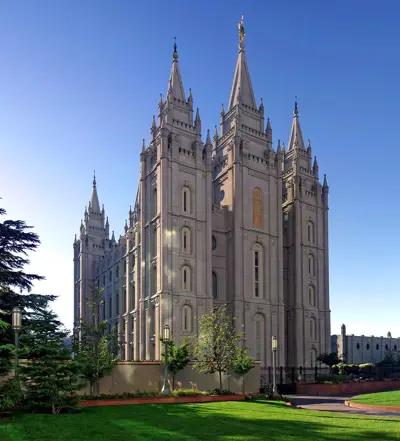
Mormons are a religious and cultural group related to Mormonism, the principal branch of the Latter Day Saint movement started by Joseph Smith in upstate New York during the 1820s. After Smith's death in 1844 the movement split into several groups following different leaders; the majority followed Brigham Young, while smaller groups followed Joseph Smith III, Sidney Rigdon, and James Strang. Most of these smaller groups eventually coalesced into the Community of Christ, and the term Mormon typically refers to members of The Church of Jesus Christ of Latter-day Saints (LDS Church), as today this branch is far larger than all the others combined. (Since 2018, the LDS Church has requested that its members be referred to as "Latter-day Saints".) People who identify as Mormons may also be independently religious, secular and non-practicing, or belong to other denominations.
