Hideki Tojo Quotes
The Japanese government has accepted the notion that Japan is the loser, and it appears to be going to accept unconditional surrender. Such a position frustrates the officers and soldiers of the imperial armed forces.
Tojo, Hideki. Statement on Japan's Surrender. 13 Aug. 1945. Quoted in Toland, John. The Rising Sun: The Decline and Fall of the Japanese Empire, 1936-1945. Random House, 1970.


After the Hiroshima bomb there was still no surrender by the Japanese. The decision was made to drop the second bomb on Nagasaki.

The Vietnam War was certainly not a victory for the U. S. Some saw it as our first defeat. While it was not ended on Johnson’s watch, he must certainly share that responsibility with Nixon and even JFK as these three all were responsible for our Vietnam failure. Johnson, ended up with what he feared most.
Actually, although the Emperor wanted to surrender, there was a military coup attempted to prevent his announcement being made to the Japanese people. Fortunately, it did not succeed, but he certainly had the alternative of fighting to the death. There were Japanese hard liners who believed that they could make the invasion of mainland Japan so costly in lives to the Allies that they could negotiate terms. The Atomic Bomb however, in the mind of the Emperor and other Japanese leaders rendered that strategy moot.
This amazing quotation was made in 2011 when he, President Xi Jinping, and some other senior Chinese leaders embarked on a reform program of the People’s Liberation Army which with decades of peace had grown soft and corruption was quite prevalent. See also {632517}.

The CIA and others had known that the Vietnam War was not winnable, yet the CIA Management and the Defense Department were stating the contrary. Gates was then an analyst for the CIA and it was his first job out of college. There was a rationale for the politicians and military leaders to lie about prospects in Vietnam. If we could not win, we wanted to negotiate a settlement on as good terms as we could get. However, if Ho Chi Min and the North Vietnamese knew that we did not think that we could win, they would have no incentive to concede on any points or compromise at all. To be successful in the negotiations, we had to persuade the Vietnamese that we thought we could win and would keep up the fighting and bombing unless they would concede some things. Unfortunately, by the time that we started negotiations, it was too late to be very successful in negotiations. All the parties to the negotiations at that point realized that we could not win. The only people who thought the contrary were a large block of American patriots who had been deceived by the politicians and the military leadership.


This was one of several petitions that were sent to the President by groups of scientists who were working on the development of the atomic bomb. The major objective of the scientists was to demonstrate the power of the bomb before it was used. The President did not select this policy of demonstration as the invasion of the Japanese mainland was imminent and America only had two bombs—one a uranium and the other, plutonium. If the demonstration would not produce the unconditional surrender, then there would only be one weapon left and it would take months to produce another. This was the strongest argument against using up a bomb. It was somewhat borne out when the Japanese did not surrender after the first bomb had been dropped on Hiroshima. It took the second.

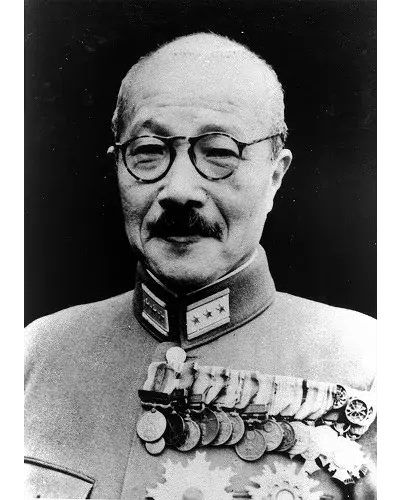
Hideki Tojo was a Japanese politician and general of the Imperial Japanese Army (IJA) who served as Prime Minister of Japan and President of the Imperial Rule Assistance Association for most of World War II. During his years in power, he assumed several more positions including Chief of Staff of the Imperial Army before ultimately being removed in July 1944.
