Robert M. Gates Quotes
We knew then that we could not win the war.
The CIA and others had known that the Vietnam War was not winnable, yet the CIA Management and the Defense Department were stating the contrary. Gates was then an analyst for the CIA and it was his first job out of college. There was a rationale for the politicians and military leaders to lie about prospects in Vietnam. If we could not win, we wanted to negotiate a settlement on as good terms as we could get. However, if Ho Chi Min and the North Vietnamese knew that we did not think that we could win, they would have no incentive to concede on any points or compromise at all. To be successful in the negotiations, we had to persuade the Vietnamese that we thought we could win and would keep up the fighting and bombing unless they would concede some things. Unfortunately, by the time that we started negotiations, it was too late to be very successful in negotiations. All the parties to the negotiations at that point realized that we could not win. The only people who thought the contrary were a large block of American patriots who had been deceived by the politicians and the military leadership.
Robert M. Gates, Director, Central Intelligence Agency, U. S. Secretary of Defense, Describing the CIA analysis assessment of the Vietnam War in 1966, From the Shadows, 1996
Sourced by: Eigen's Political and Historical Quotations

Komer, Wesmoreland, and the Military Command in Vietnam had been lying about American success in the Vietnam War. The CIA analysts (see {634522}) had figured out that if the Westmoreland numbers of enemy killed were correct, there would have been almost no young men left to fight in North Vietnam, and yet their military was as large and strong as ever. The CIA director sent Carver to Saigon to tell Komer and Westmoreland that CIA was about to issue their findings. Komer was an ultra-hawk, known as “Blowtorch Bob”, who had personally sent many memos to the White House reporting that we were winning in Vietnam and the only question was how soon we could attain total victory. For his work in Vietnam, he was made Ambassador to Turkey. He was awarded the Presidential Medal of Freedom by LBJ. Some critics believe that Johnson’s after Vietnam treatment of Komer was to assure his silence as he knew everything about the deception and was a major perpetrator of it. Discipline for lying was out of the question with someone who knew all that Komer did.


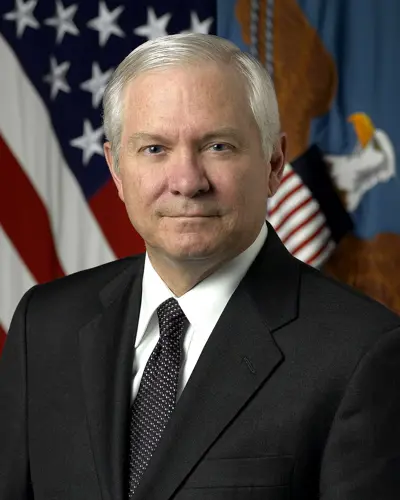
Robert Michael Gates is an American intelligence analyst, and university president who served as the 22nd United States secretary of defense from 2006 to 2011. He was originally appointed by President George W. Bush and was retained for service by President Barack Obama. Gates began his career serving as an officer in the United States Air Force but was quickly recruited by the Central Intelligence Agency (CIA). Gates served for 26 years in the CIA and the National Security Council, and was Director of Central Intelligence under President George H. W. Bush. After leaving the CIA, Gates became president of Texas A&M University and was a member of several corporate boards. Gates served as a member of the Iraq Study Group, the bipartisan commission co-chaired by James A. Baker III and Lee H. Hamilton, that studied the lessons of the Iraq War.
