Fulton J. Sheen Quotes
The industrial and social injustice of our era is the tragic aftermath of democracy's overemphasis on freedom as the "right to do whatever you please." No, freedom means the right to do what you ought, and ought implies law, and law implies justice, and justice implies God. So too in war, a nation that fights for freedom divorced from justice has no right to war, because it does not know why it wants to be free, or why it wants anyone else to be free.
Sheen, Fulton J. Philosophies at War. Scribner, 1943, p. 42.


He was announcing war with Germany.


Muir was tried and convicted for sedition for his speech, and at his trial in August 1793 he repeated the quotation claiming that it was not seditious. He was advocating extending the vote to male, non-land owners. See Robert MacQueen Braxfield.


He had written this at the request of Joan van der Capellen, the Dutch revolutionist, to have a Christian theological justification for revolution against the then Dutch monarchy. See {639741} and {639742}.


Note that the two do NOT ALWAYS coincide. There are those who argue that law should be respected, right or wrong. There are also those who argue that law should be respected, only when it is in the right. Note also that “respect” and “obedience” are two different things. Some people argue that law and the courts and government must have respect. Others that they are only due obedience but not necessarily respect when they are in the wrong. Still others, like Thoreau, that obedience even is not required when the law is wrong. There are those who take this to the degree that obedience to a “wrong” law is wrong and there is a DUTY to disobey a wrong law. However, a more nuanced view does not treat all laws as the same importance. I may think a particular tax is unjust and wrong, but obedience does not necessarily have moral consequences. A law that says that people with a certain religion must not be hired, however, is sufficiently immoral that I am obliged to disobey it.


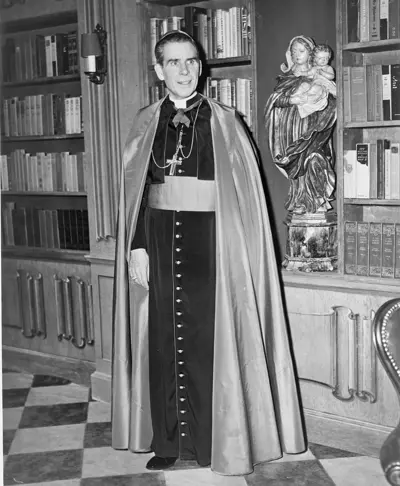
Fulton John Sheen was an American bishop (later archbishop) of the Catholic Church known for his preaching and especially his work on television and radio. Ordained a priest of the Diocese of Peoria in 1919, Sheen quickly became a renowned theologian, earning the Cardinal Mercier Prize for International Philosophy in 1923. He went on to teach theology and philosophy at the Catholic University of America as well as acting as a parish priest before being appointed Auxiliary Bishop of the Archdiocese of New York in 1951. He held this position until 1966 when he was made the Bishop of Rochester. He resigned in 1969 as his 75th birthday approached, and was made the Archbishop of the titular see of Newport, Wales.
