Calvin Coolidge Quotes
The government of the United States is a device for maintaining in perpetuity the rights of the people, with the ultimate extinction of all privileged classes.
Calvin Coolidge, 1872-1933, 30th President of the United States (Republican, MA), Speech, Philadelphia, PA, September 25, 1924
Sourced by: Eigen's Political and Historical Quotations


Most politicians at the time agreed with this statement. In the next 25 years, the economic system grew less fair and when government officials tried to come up with remedies, they sublimated fairness, to economic recovery, and America went through a phase where fairness was far less important then it traditionally had been.

This quotation had a close proximity to Lincoln’s Gettysburg Address {458852}. Although this was probably Lincoln's most famous, was not totally original. John Adams came close in a 1774 proclamation {598723}. As did John Marshall in his McCulloch v. Maryland decision. Daniel Webster's Speech on Foot's Resolution was very close {606471}. There was also Thomas Cooper in 1795 {598723} . But the earliest close phrase use appears to be John Wycliffe in 1382 {567292}. It is not known with which of these Lincoln was familiar,

A classic potential conflict is between attaining liberty AND justice. In quest for one, the other can suffer. Many reforms and revolutions do not get this balance right.

This remarkable statement was written in about 1840 and there was probably then few people of either gender who would think such a thing possible.


He was an American resident at the time he gave this speech.


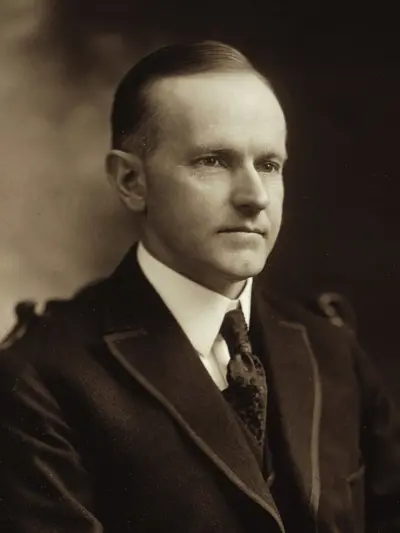
Calvin Coolidge was an American lawyer and politician who served as the 30th president of the United States from 1923 to 1929. A Republican lawyer from New England, born in Vermont, Coolidge worked his way up the ladder of Massachusetts state politics, eventually becoming governor of Massachusetts. His response to the Boston Police Strike of 1919 thrust him into the national spotlight and gave him a reputation as a man of decisive action. The next year, he was elected the 29th vice president of the United States, and he succeeded to the presidency upon the sudden death of Warren G. Harding in 1923. Elected in his own right in 1924, he gained a reputation as a small-government conservative and also as a man who said very little and had a rather dry sense of humor.
