Denis Diderot Quotes
The good of the people must be the great purpose of government. By the laws of nature and of reason, the governors are invested with power to that end. And the greatest good of the people is liberty.
Denis Diderot, 1713-1784, French Philosopher, L'Encyclopédie
Sourced by: Eigen's Political and Historical Quotations


Spinoza was one of the most feared intellectuals in human history—feared, that is, by the established power structures. Spinoza’s ideas were considered so radical and dangerous that he was the only man in history who was excommunicated by the Catholics, the Jews and the Muslims.


This has been one of the fundamental debates in America since its founding. Which is more important, the preservation of civil rights and personal liberty or the supremacy of the law and the stability of our institutions. In war, the tension is always existent. In law enforcement, there is also a common conflict. Prohibition, like the later War on Drugs, was not able to be enforced without the invasion of personal rights. Americans decided that Prohibition benefits were not worth it/ The debate is ongoing with respect to the War on Drugs.

Note that Jefferson felt that governmental powers were limited even without a constitution.

It was a quasi constitution in limited areas and declared the representatives of the people coordinate with the governor and council, and that no taxes could be laid without their consent—a degree of freedom and self-determinism what was far greater than those of the other colonies save Pennsylvania. Several years earlier, the English portion of the colony clamored for representative government and was ready to break into open rebellion against Governor Edmund Andros and the authority of the Duke of York. The Duke promised an elected assembly and 18 elected New Yorkers constituted the first representative assembly. Their first act was to pass the Charter of Liberties which was approved by the Duke’s new Governor Thomas Dongan. So the Charter of Liberties was the first set of laws in America passed by a vote of elected representatives of the people.

This constitution, 13 years later, became the basis for the national Batavian Constitution.

“Magistrates” at the time were rulers and heads of government and state. There was little or no separation of powers and the chief magistrate could make edicts and laws, enforce them and be the judge and jury as well. In the United States, the President is also called the “Chief Magistrate” even though his powers are only within the Executive Branch. For us today, “Magistrate” usually refers to a judge or other official of the Judicial Branch.


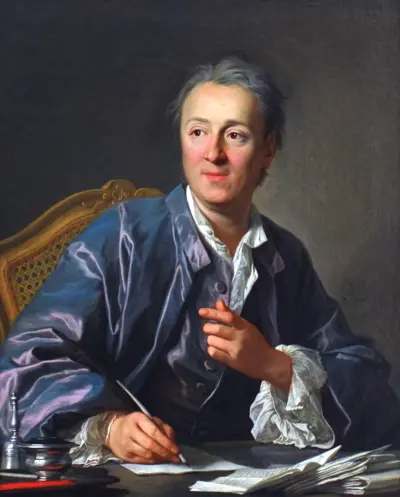
Denis Diderot was a French philosopher, art critic, and writer, best known for serving as co-founder, chief editor, and contributor to the Encyclopédie along with Jean le Rond d'Alembert. He was a prominent figure during the Age of Enlightenment.
