Pieter Vreede Quotes
Liberty is an inalienable right, adhering to all residents of the Netherlands commonwealth. No power on earth, much less any power derived truly from the people … can challenge or obstruct the enjoyment of this liberty …
This constitution, 13 years later, became the basis for the national Batavian Constitution.
Pieter Vreede, 1750–1837, Dutch Politician, Revolutionist & Political Writer, Leader of the National Democracy Advocates, Wijbo Fijnje, 1750–1809, Dutch Mennonite Minister, Politician, Publisher, & Revolutionist, Leiden Draft Constitution (Leiden Ontwerp), ~1783
Sourced by: Eigen's Political and Historical Quotations

This statement summarized what had been a basic principle of American Law as derived from English law. See {587704}.

See {587703} for a similar statement by a Supreme Court Justice.


Jefferson and some of the other Founding Fathers saw the American experiment as having implications for the whole world. To Jefferson, the Declaration of Independence was not just for Americans but ideally for all mankind.


Most politicians and philosophers would argue that liberty is both an individual right and a group right. However there are money who do not recognize group rights and feel that they are inimical to individual rights.

It is ironic that Pakistan, the creation of Jinnah’s efforts, has to a great extent adopted Sharia (Islamic Law) resulting in severe curtailment of freedom of speech and thought. Professors languish in jail for not teaching the history of Muhammed in the orthodox way, people are sentenced to death for what the local mullahs regard as blasphemy—results which from Jinnah’s point of view were terrible.


Hayward claimed that Wilson was the first American President who ever criticized the American Constitution. Many do not agree as Madison and Jefferson in part, along with most other Americans, found the Constitution so wanting that it was ratified only on condition of the passage of the Bill of Rights. Jackson, was distressed by the limitations on the President and many others had their objections, but Wilson, before he became a politician was a prominent academic political scientist and wrote voluminously and had an intellectual following so his criticism was not considered so “political” as others.

This quotation was used ten years later by Virginia which, in convention, passed a resolution objecting to the Alien & Sedition Acts. The drafter of the original resolution was James Madison.

The call for individual liberty and the right of personal property by clergy is surprising to many. This Cahier was the consensus of the Clergy of Blois in 1789. There were cahiers of several provinces of France—some by the clergy, some by the nobles. What is fascinating is the emergence of many of the pre-Revolutionary French concepts. The example of the American revolution and its principles was known throughout the educated classes of France.


This is a remarkable quotation. Because of the issue of plural marriage, many Americans regarded the early Mormons as having no respect for the country or its laws. However, as this quotation shows, the Mormon leader, prophet and founder specifically commanded his people to not only support the United States law but specifically mentions The Constitution. He told his followers that God approves of the United States constitution and states that it is in a sense universal, belonging to all mankind. There is no other religious founder who so thoroughly validated a national constitution and system in the history of the world. Yet he was assassinated and after his death, the United States Government was almost in a full scale war with the Mormons. There is still a vestige of anti-Mormonism in the United States among some Christian Fundamentalists. Yet the Mormon church has been a thoroughly American church, historically, conceptually, and philosophically It has even shared some of the American historical errors such as its sexism and discriminatory rules and view of Blacks. The latter has been remedied {625268} as the rest of America has changed, and the discriminatory role of women is very traditional and is shared with most other Christian fundamentalists and orthodox Jews.

Crockett and a large group of Tenesseeans all died defending the Alamo for the Liberty and Independence from the Mexican Dictator, Santa Anna.
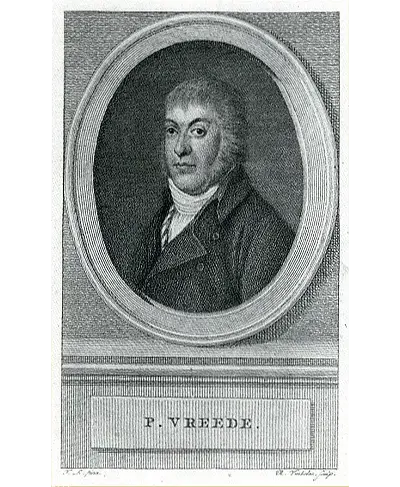
Pieter Vreede was a Dutch politician of the Batavian Republic in the 18th century. Vreede was born in Leiden and died in Heusden. He was a prominent critic of stadholderian misrule and of the urban patriciate.
