Lyndon B. Johnson Quotes
The Four Great Powers? Who the hell are the other two?
The Israeli Foreign Minister conveyed to the President the suggestion of French President De Gaulle that the "Four Great Powers" ought to get together:
Lyndon Baines Johnson, 1908-1973, 36th President of the United States (Democrat, TX), Remark to Abba Eban, May 26, 1967
Sourced by: Eigen's Political and Historical Quotations

They were both children of Queen Victoria of England.


He was right. Before WWII Russia was not considered a very important country in the world, but having emerged from WWII, Russia was stronger than ever and counties like Germany and Italy were in ruins.


Leval was an appeaser and a collaborator with the Nazi’s. He led the government in name but the Germans really controlled the country. His actions killed tens of thousands of French men and women by turning them over to the Germans. After the Germans were defeated in WWII, Leval was shot as a traitor by the Free French forces.

The great European powers were attending an International Congress—Summit Meeting of the heads of government and their diplomats to deal with the crisis of Tsarist Russian military expansionism. None of the other European powers of the time wanted or could afford war so Russia could only be thwarted by Great Britain. There were many in England who thought that the British should not even attend and should send troops immediately. The Queen and the Royal Family were among those. At the Congress Disraeli, who had much personal affection for Queen Victoria, wanted to reassure her. 1st Earl of Beaconsfield. If the Congress did not succeed the mainland of Europe would have been at war. Disraeli obtained everything England wanted. See Russian Ambassador Prince Gortchakoff’s observation.

Because the early nation's government was still in a state of becoming, foreign powers were hesitant to do business and conclude treaties with the newly-formed United States of America:

Cooper had resigned from the government after Prime Minister Neville Chamberlain returned from his meeting with Hitler with the naïve view that peace could be made with Germany. There was a significant pro-Fascist, Nazi sympathetic segment of British society including the former King, the Duke of Winsdor, who were in favor of making an alliance with Hitler and not opposing the Nazi “reform” of Europe. Surrender was his word for their alternative.

The Prime Minister was visiting the United States and was staying at the White House. President Roosevelt had a spontaneous thought and wheeled himself into Churchill's room. The Prime Minister was stark naked, having just emerged from the bath. Roosevelt apologized but Churchill was unfazed and known for his nudity in his private quarters. He even used what might have been an awkward moment into an opportunity to make a political point.

The then Attorney General had established a back channel to the Russian agent. There was genuine fear by the Russians and some in America that there were still many Nazis and German nationalists who would try and influence, if not take over, German politics to produce another aggressive German fascist state. The Russians had lost 22 million citizens to the Germans in the war and had faced a defeated Germany where virtually every German over the age of 30 had been cheering for and supporting Hitler a decade ago. Neither the Russians nor we and the other allies had not yet seen the remarkable turn-around that the German nation would make and the intense anti-fascist, non-military ethos that would be brought by the younger German generations. The direction of Germany was then very unpredictable.

See {138034} for one world leader’s candid view of treaty obligations.

He used the “united nations” as a general description as the UN had not been created or named yet, However, as this quotation demonstrates, the President was already thinking about a UN idea, but as a realist, he explained that the great powers had to come to some agreement of interests. Actually China and France, at the time, would go along with whatever the United States and Britain wanted to do and had a great common interest, and there was already a strong association of interests between Britain and America. Russia was to be the problem and a complete common interest was never to be, but there was enough to get the United Nations started.


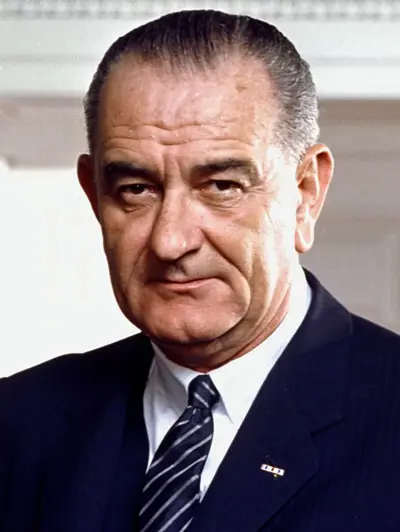
Lyndon Baines Johnson, often referred to by his initials LBJ, was the 36th president of the United States, in office from 1963 to 1969. He served as the 37th vice president from 1961 to 1963 and assumed the presidency following the assassination of President John F. Kennedy. A Democrat from Texas, Johnson was also a United States representative and later majority leader in the United States Senate. Johnson is one of only four people to have served, at various times, in all four federal elected positions.
