Jorge Luis Borges Quotes
The Falklands things was a fight between two bald men over a comb.
Jorge Luis Borges, 1899-1986, Argentinean Poet and Novelist, Quoted in Time, February 14, 1983
Sourced by: Eigen's Political and Historical Quotations


He was a brutal, sadistic war criminal who was assassinated by one of his many enemies in 2000 before he could be brought to trial.


President Eisenhower was asked if there was any danger of the country getting inadvertently drawn into a war in Vietnam as the result of sending military "advisors":

He was referring to President Jefferson’s inclination to send the military against the Barbary Pirates. They had an incredible extortion racket going in the Mediterranean. If nations would pay them an annual sum each year, they would not attack and seize merchant ships of that country and sell the ships and goods while holding the sailors for ransom. Note that Congress was not very well respected at that time which Jay and most leaders did not think was a good thing, much like in the 21st century.


At this point, the horrors of the German concentration death camps were generally known by the world press. This quotation shows the denial that the Irish Free State was in about the German Nazi atrocities. The 6-county Nationalsits were the Irish counties in Northern Ireland that did not join the Irish Free State and so far as the Catholic Irish were concerned, the Catholics of Northern Ireland were a persecuted minority undergoing oppression and that was not they believed morally different from the murders of millions of Jews, Gypsies and handicapped people in Europe. If the Free State Irish publicly admitted the difference, they would morally have had to join the allies and De Valera was totally opposed to that. Over 70,000 Irishmen and women rejected the moral stand of their government, and volunteered for the British Army to the great distress of the Free State leaders like De Valera. See {639722} for his personal denial of reality.

Under the treaty between Ireland and England that created the Irish free state, in case of war or other contingency, the Irish Free State was required to allow Great Britain to use specific seaports. However, De Valera hated the English, originally opposed the treaty, and was adamant that the Irish Free State be neutural in WWII. He therefore refused to fulfill the Irish obligation. For Churchill this was the last chance for De Valera to show that the Irish Free State was a real nation with rights and obligations. Interestingly, although De Valera did not want to assist the British fighting the Germans, over 70,000 Irishmen went to England and Volunteered to fight on the British side. There were Irish batallions fighting on the allied side but the Irish Free State was neutural. De Valera made matters worse when he allowed German agents into the Irish Free State to try and go from there to England as well as set up observation posts to guide German bombers attacking the populated city of Belfast and other parts of Northern Ireland. See {639724} for Chirchill’s later reflective commentary on the situation.
The Boers had just a few years before lost their war with the British who were then in control of South Africa. However, the British did not treat the Boers harshly in defeat and most Boers were at the time farmers and land owners who were a major force in democratic South Africa and had much invested in the nation. Others were still resentful of the British. The Boers sided with the British and fought the Germans who had troops and colonies in Africa. Like the Irish, culturally, they were always up for a good fight.

1914 was the outbreak of WWI in which all the belligerents had very different interests and reasons for war—even allies on the same side greatly differed as to their motivation for fighting.

The Germans did not believe the British would send land troops. See {642105}.

The Times regretted that the Germans did not speak to the Austrians more vigorously when they were threatening to attack Serbia who harbored anti-Austro-Hungarian terrorists (see {642085}). What the Times editors did not realize was that the Germans had already made their war plans (see {642092}) and the Serbian issue was just the justification they needed to implement them. So there was no real reason for the Germans to discourage the Austro-Hungarian Empire from its mission to punish Serbia.

1st Viscount Grey of Fallodon


The concept of race then was not what it is today where it is, if anything, a genetic or anthropological distinction. Then race was a combination of blood (genetics) and culture. Wittgenstein, an Austrian by nationality, considered himself German racially. This concept of race was common in 1914 and rose to be absolute in the Nazi era. So the absorption of Austria by Germany did not seem to most Austrians a diminution of anything but a natural recognition of the unity of one people—the German race. Wittgenstein was not alone among intellectual “Germans” who believed the English “race” superior. Their ability to operate a democracy without a powerful leader was considered a great strength as was the diffusion of power and control were both admirable accomplishments which some German intellectuals envied.


American official foreign policy had been officially isolationist—to not get involved in the squabbles and fights of other nations. Angell however pointed out that even before WWII, America had formally been involved in 6 foreign wars and used military incursions on foreign soil on almost 100 occasions.
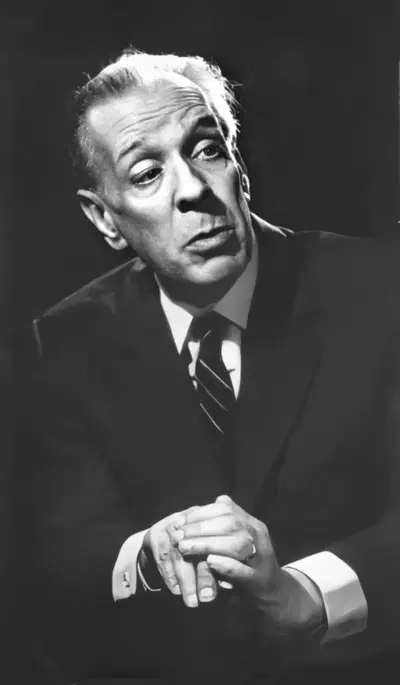
Jorge Francisco Isidoro Luis Borges Acevedo was an Argentine short-story writer, essayist, poet and translator, and a key figure in Spanish-language and universal literature. His best-known books, Ficciones (Fictions) and El Aleph (The Aleph), published in the 1940s, are compilations of short stories interconnected by common themes, including dreams, labyrinths, philosophers, libraries, mirrors, fictional writers, and mythology. Borges' works have contributed to philosophical literature and the fantasy genre, and have been considered by some critics to mark the beginning of the magic realist movement in 20th century Latin American literature. His late poems converse with such cultural figures as Spinoza, Camões, and Virgil.
