James Wilson Quotes
The executive power is better to be trusted when it has no screen. Sir, we have a responsibility in the person of our President; he cannot act improperly, and hide either his negligence or inattention; he cannot roll upon any other person the weight of his criminality; no appointment can take place without his nomination; and he is responsible for every nomination he makes…. Add to all this, that officer is placed high, and is possessed of power far from being contemptible, yet not a single privilege is annexed to his character; far from being above the laws, he is amenable to them in his private character as a citizen, and in his public character by impeachment
James Wilson, 1742-1798, Legal Philosopher, U. S. Supreme Court Justice, Pennsylvania Delegate to the Continental Congress & the Constitutional Convention, Speech, Pennsylvania Constitutional Ratification Convention
Sourced by: Eigen's Political and Historical Quotations


In England, the King was above the law. However, impeachment was a tool that could be used against his favorite ministers. In debating the United State Constitution one of the first questions to be determined was whether impeachment could be a tool used against the President or like, England, only the other government officials. Franklin urged the President be included. See also Mason: {584246}.
The debate was about the unlimited pardon power of the President. Madison argued that the check was the impeachment power. However, Presidents had tended to make large numbers of pardons just before they leave office so the impeachment power works only as a check for the beginning and middle part of their term.


The convention turned down the constitution and would not ratify it until the Bill of Rights was passed later. By modern standards, Presidents in modern times have withheld much information from the Congress and in some cases such as the George W. Bush administrations, the President and his cabinet frequently lied to the Senate, the House, and the American people with no effort made to impeach. Based on the original intent of the Americans ratifying the Constitution, the Executive Branch may not keep anything material to the security of the country secret from Congress. But the center of both parties reject this regardless of what the original intent was.

President Thomas Jefferson himself forwarded to the House some of the evidence against Pickering, the first Federal Judge to be removed by impeachment.

In England, the King was above the law. However, impeachment was a tool that could be used against his favorite ministers. In debating the United State Constitution one of the first questions to be determined was whether impeachment could be a tool used against the President or like, England, only the other government officials. Mason argued that the President must be included and his view prevailed. See also Benjamin Franklin: {642885}.


The reason that this quotation is particularly important is that Taft, in addition to being a President, was also the Chief Justice of the Supreme Court, the only Supreme Court Justice to become President.

The convention turned down the constitution and would not ratify it until the Bill of Rights was passed later.
This article of impeachment is quoted often because it shows that criminal activity or violation of a law was not required for impeachment. The time was close to the adoption of the Constitution and presumably reflected sentiment of the founders. Chase however was acquitted as the Senate did not agree that the charges had been proven.

That is one view—the one tried the most frequently by Presidents who by their own estimates didn’t get a responsive civil service working to his priorities. Presidents like Teddy Roosevelt, Franklin Roosevelt, and Dwight Eisenhower and Lyndon Johnson had great cooperation from their civil servants; they instead appointed very competent people with strong senses of fairness and leading personnel. Ronald Regan tried both techniques. He used Wilson’s technique in his Education and Justice Department where there was slow-rolling and dissonance when his appointees tended to be ideologues with little or no outstanding professional competence in the fields they supervised. However, his military and State Department bureaucracies was very responsive to his appointees who were excellent leaders.


Note that early constitutional experts assumed that one of the President’s roles was to be non partisan and control partisanship. Note the phrase ‘prevent the artifices of party’. The early founders were very wary of political parties of ‘factions’ as Madison called them. However, most were extremely partisan although in the Presidency partisanship was toned down by George Washington but after him, partisan ship became the norm.

Alberto Gonzalez, White House Counsel and later Attorney General who was forced to resign and David S. Addington, Counsel to the Vice President, had come up with a novel view of the powers of the presidency. They argued that since the President is the Commander in Chief, in a war situation or intelligence gathering thereto, has the Constitutional responsibility for that function, he need not obey any laws of Congress as in the conduct of the war Congress would be impinging on the Constitutional separation of powers which itself was prohibited by the Constitution. The argument did not find any significant legal support but for a while the George W. Bush White House behaved as if this were the law, despite the fact that even in the American Revolution and the War of 1812 Congress passed laws regulating the conduct of the armed forces as is provided for in other parts of the Constitution. Yet even Goldsmith would allow the President some powers that many think are unconstitutional and/or belong to Congress. See {32436}.

Wilson was one of the group that opposed a triumvirate or multiple executive. He led the argument that unless there was a single Executive, no one could be held responsible.
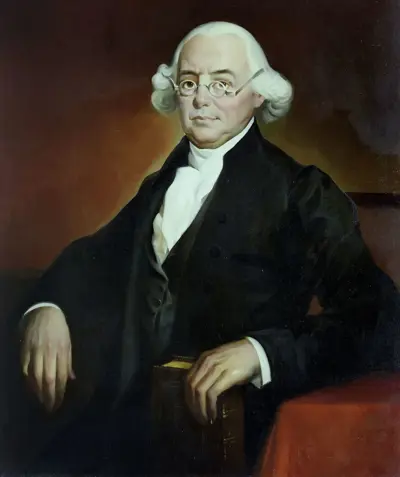
James Wilson was one of the Founding Fathers of the United States and a signatory of the United States Declaration of Independence and the United States Constitution. Wilson was elected twice to the Continental Congress, where he represented Pennsylvania, and was a major force in drafting the United States Constitution. A leading legal theorist, he was one of the six original justices appointed by George Washington to the Supreme Court of the United States.
