James Wilson Quotes
A single Executive may be responsible, but a numerous one cannot be responsible.
Wilson was one of the group that opposed a triumvirate or multiple executive. He led the argument that unless there was a single Executive, no one could be held responsible.
James Wilson, 1742-1798, U. S. Supreme Court Justice, Pennsylvania Delegate to the Continental Congress & the Constitutional Convention, Debate, Constitutional Convention, Philadelphia, 1787, Quoted in the Notes of Rufus King
Sourced by: Eigen's Political and Historical Quotations


He supported the Presidential concept as the least worst option.

Seven states was then a majority of the states.

This proposal is amazingly close to where we have ended up after the Constitutional amendment limiting the President to two 4 year terms. Mason’s reasoning however was very different. He assumed that the legislature would elect the President.

Randolph was one of the delegates who opposed a Presidency of a single man.


That is one view—the one tried the most frequently by Presidents who by their own estimates didn’t get a responsive civil service working to his priorities. Presidents like Teddy Roosevelt, Franklin Roosevelt, and Dwight Eisenhower and Lyndon Johnson had great cooperation from their civil servants; they instead appointed very competent people with strong senses of fairness and leading personnel. Ronald Regan tried both techniques. He used Wilson’s technique in his Education and Justice Department where there was slow-rolling and dissonance when his appointees tended to be ideologues with little or no outstanding professional competence in the fields they supervised. However, his military and State Department bureaucracies was very responsive to his appointees who were excellent leaders.


Mead argues that this is a trend that has been operating over many administrations. It could be argued that modern communications and the media have been significant drivers of this phenomenon along with the desire for White House staff to have as much control as they can obtain. Before modern communications, an Ambassador, or a Secretary of Commerce had to make decisions within the philosophical and political umbrella of the President’s general policies. They could not communicate immediately with the President or his staff. But once everyone in the government was connected, the President’s staff could make every important decision. However, with the many different major issues and emergencies of the modern era, the small group in the What House have not been able to deal with them all and the bureaucracy has been instructed not to decide big things without going through the White House. See {642086}.

In England, the King was above the law. However, impeachment was a tool that could be used against his favorite ministers. In debating the United State Constitution one of the first questions to be determined was whether impeachment could be a tool used against the President or like, England, only the other government officials. Franklin urged the President be included. See also Mason: {584246}.
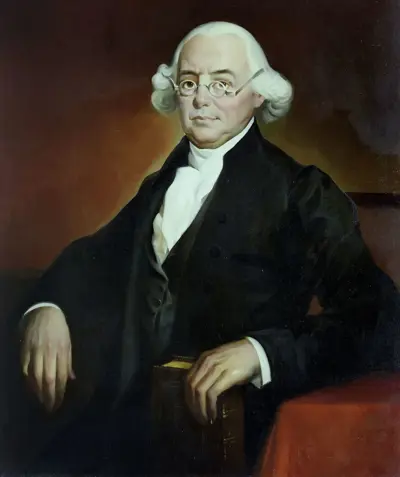
James Wilson was one of the Founding Fathers of the United States and a signatory of the United States Declaration of Independence and the United States Constitution. Wilson was elected twice to the Continental Congress, where he represented Pennsylvania, and was a major force in drafting the United States Constitution. A leading legal theorist, he was one of the six original justices appointed by George Washington to the Supreme Court of the United States.
