Barack Obama Quotes
The easiest way to get on television these days is to be extremely rude.
Barack Obama, 44th President of the United States (Democrat, IL), Interview, ABC This Week, September 20, 2009
Sourced by: Eigen's Political and Historical Quotations

The 1980 presidential campaign was held in the middle of the Iran hostage crisis. President Carter remained in the White House and left the campaigning to the Vice President who received very light news coverage:


Vidal was perhaps the first Politician to realize the importance that television would have on politics and celebrity.

The Democrat campaign operators, led by Robert Woolley, for the first time in an American Presidential campaign, used all the new techniques of public relations and advertising that had been developed. Many observers like the New Republic editors saw this in a negative light for American democracy. They wanted the old method where people met the candidates and had discussions with candidates or heard from others who had. It was in retrospect an editorial of nostalgia, as the country was growing so much that voter “acquaintance” with Presidential candidates was becoming more and more difficult.


Even as late as the 1970s most media organizations did not feel any inhibition about having a spokesperson for a political movement or candidate comment about statements that were clearly untrue. The constant political criticism of the media produced this change and no matter how absurd or false a political statement is, most media will have a spokesperson for the lie appear on the program to repeat the lie. Both political parties are thereby encouraged to exaggerate or even lie as they will never by exposed by trusted journalists and can reduce all falsehoods to a “he says, she says.”


Ronald Reagan’s media expert, Michael Deaver, developed a new approach to Presidential appearances. He realized that if the President made a 5 or 10 minute speech at an event, the Evening News would choose one or two 10-15 second excerpts, and that was what the vast majority of the country would see. Therefore, he reasoned, the words spoken meant relatively little. It was the image what would last in people’s memory. Therefore, he worked hard to concentrate on getting the right background for the President’s appearance. The Statue of Liberty, a naval ship, a factory at work. The set of images that people would have of the President in these different appearances would define the President in the minds of most people. Deaver would be more concerned that the TV camera’s showed the background scene he had planned (rather than a strange angle or just a close-up of the President’s face) than he would be about which words—sound bytes—the TV station would select. Hence Baker’s observation that words were less important than the TV images.


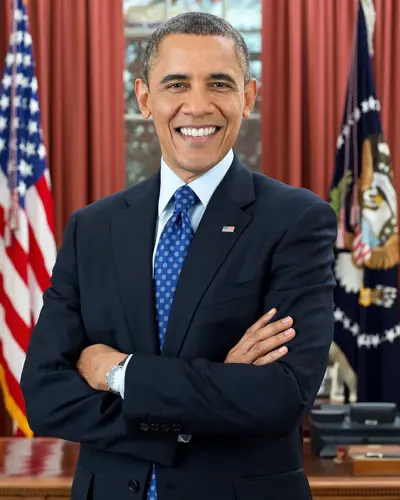
Barack Hussein Obama II is an American politician and attorney who served as the 44th president of the United States from 2009 to 2017. A member of the Democratic Party, Obama was the first African-American president of the United States. He previously served as a U.S. senator from Illinois from 2005 to 2008 and as an Illinois state senator from 1997 to 2004.
