Andrew Jackson Quotes
The authority of the Supreme Court must not ... be permitted to control the Congress, or the Executive, when acting in their legislative capacities.
Andrew Jackson, 1767-1845, 7th President of the United States (Democrat, TN), Speech, 1832
Sourced by: Eigen's Political and Historical Quotations


Some of the Founding Fathers did not conceive of the kind of judiciary where Federal courts could nullify an act of the Congress by declaring a law unconstitutional. Morris was one. Others did. The Constitution is not very explicit on this point, but the nation has settled with a process that would have surprised Morris and a few others.

The view that the Supreme Court was the final arbiter of constitutional controversies was not held in early America.

In many nations, there is little judicial independence from the government. Judicial decisions that thwart government sometimes produce retaliation ranging from reducing the pay or staff of judges, threatened investigations and impeachment even arrest and execution---sometimes by government ‘death squads’. Even in the United States, the beginning of the 21st century, was fraught with so many examples of judicial intimidation threats, that two Supreme Court justices began speaking throughout the country to educate the public to this problem. In general, the more democratic and free a nation is, the more frequently the courts will disallow activities of the executive and even the legislature.

Marshall is famous for, as Chief Justice, establishing the principle that the Judiciary can override Congress and the Executive in determining Constitutionality. However, as this quotation illustrates this principle had been discussed in open debate on the ratification of the Constitution. It was not simply a grab for power by a Chief justice; he uttered this quotation long before he ever suspected he would be a judge but actually spent much of his career in the executive and legislative branch of government.


One of the conundrums of our constitutional system is who has the last word as to what the Constitution means. Essentially it is the judicial branch headed by the Supreme Court. But there are those who believe that the current popular majority should have a say in what is or is not constitutional. If so the legislative branch should have the last word. Still others say that the President is the only person elected by ALL the people, so his opinion most reflects the will of the public. And then there are most who argue that the Constitutional system was created just to avoid the power of currently popular majorities, and the courts should decide based on the Constitution itself. So the statement has very little meaning except that Phillips thinks that the courts have too much power. Whoever gets to decide what is or is not Constitutional will be accused of being “over” the Constitution by those who don’t like the decisions. In our system, that is the courts.

President Abraham Lincoln had pocket vetoed his own party's reconstruction bill in the midst of an election year.


In general, Justice Jackson was correct. Almost all major Supreme Court decisions that have ruled against the Legislative Branch or the Executive Branch, have been, reversed by a future Supreme Court, reversed by new legislation, reversed by a subsequent Constitutional Amendment, reversed by science or technology, or acknowledged by future generations to be wrong but were now moot and needed no correcting. The greatest of the Supreme Court decisions have generally been those that upheld the Congress and the Executive.

Vidal, a staunch liberal held this view along with many ultra conservatives end extreme liberals. The constitution requires the Congress to declare war, but they have not done so for any of the wars since WWII. The President assumed the war power. And the only coherent budgets began.


When the Senate was debating the Gulf of Tonkin Resolution, which would empower the President to take "all necessary measures" to repel any armed attack on U. S. forces, Senator Morse was one of only two Senators opposing the resolution:


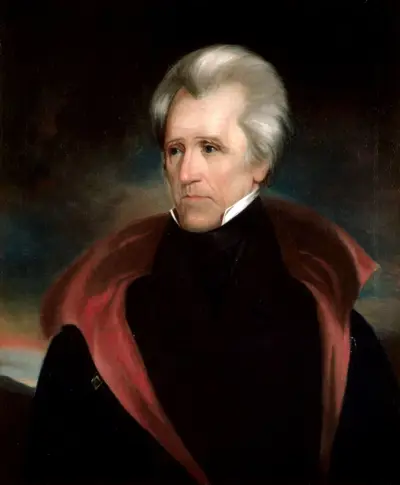
Andrew Jackson was an American lawyer, soldier, and statesman who served as the seventh president of the United States from 1829 to 1837. Before being elected to the presidency, Jackson gained fame as a general in the United States Army and served in both houses of the U.S. Congress. An expansionist president, Jackson sought to advance the rights of the "common man" against a "corrupt aristocracy" and to preserve the Union.
