Chief Joseph Quotes
Tell General Howard I know his heart. What he told me before I have in my heart. I am tired of fighting. Our chiefs are killed. Looking Glass is dead. Toohoolhoolzote is dead. The old men are all dead. It is the young men who say yes and no. He who led the young men is dead. It is cold and we have no blankets. The little children are freezing to death. My people, some of them, have run away to the hills, and have no blankets. The little children are freezing to death. My people, some of them, have run away to the hills, and have no blankets; no food; no one knows where they are, perhaps freezing to death. I want to have time to look for my children and see how many I can find. Maybe I shall find them among the dead. Hear me, my chiefs. I am tired. My heart is sick and sad. From where the sun now stands, I will fight no more forever.
In 1877 Gen. O. O. Howard and 600 men fought Chief Joseph and his Nez Perce warriors near Kamiah, Idaho. Outnumbered and outflanked, Chief Joseph headed his band toward the Canadian border, but before they reached it they were captured. Chief Joseph's surrender speech was recorded by General Howard's adjutant: Thunder Rolling Down the Mountain
Chief Joseph, c. 1840-1904, Nez Perce Chief, Quoted in F. Haines, The Nez Perces, University of Oklahoma, 1955
Sourced by: Eigen's Political and Historical Quotations


Islamic fundamentalist terrorists demanding an independent Islamic state in the middle of Russia had terrorized the people of the capital extorting money, beheading people and stealing property to fund their activities. The Russian military came in to attack the terrorists but with such a heavy hand that they did not distinguish very well between the terrorists and the regular civilian population, even torturing inhabitants suspected of aiding the terrorists when the suspects themselves had been tortured and threatened by the terrorists and they had seen many who did not cooperate killed. The people—and especially the women—were caught in the middle.

Logan was considered a great orator by Indians and whites alike. See {620551} .


It was this code, and its implementation in Saipan, Okinawa, and other Japanese held islands taken by the allies that caused Japanese soldiers to fight to the death or commit suicide. The prospect of this code being followed by Japanese soldiers, civilians or both in an invasion of the Japanese mainland, was one of the major arguments in favor of dropping the Atomic Bomb in World War II.


This speech was officially prepared and read to the six Indian tribes of the Iroquois Nation. The purpose was to persuade the Iroquois Indians to stay neutral (see {583726}) in the coming conflict with England. The Iroquois had traditionally traded peaceably with the colonists and on many occasions the colonists and the Iroquois had fought against the French and other Indians. Unfortunately, a Mohawk chief, Joseph Brant, had traveled to England and been educated there. He, following the conventional wisdom of the day persuaded most of the Iroquois tribes to join the obvious winner—England—and fight on their side. Only the Oneida tribe resisted Brant’s advice, and joined the revolutionists. The result was a civil, fratricidal war of not only white, but also the Iroquois Indians who had been at peace with each other since any could remember. When the colonists won, the Oneida were warmly embraced and participated in New York and other colonial life and activities. The relationship was so good that a little over 200 years later the average earnings of the Indian in New York State exceeded that of the average white man. The other 5 Iroquois tribes however were attacked and driven out of their traditional territories and they fled with Joseph Brant to English Canada where they have not yet fully recovered their important place in the society.
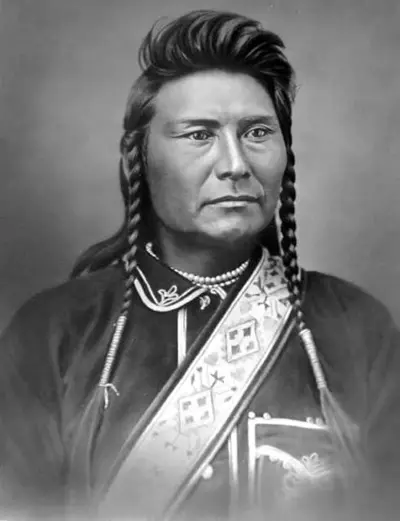
Hin-mah-too-yah-lat-kekt (or Hinmatóowyalahtq̓it in Americanist orthography), popularly known as Chief Joseph, Young Joseph, or Joseph the Younger, was a leader of the Wal-lam-wat-kain (Wallowa) band of Nez Perce, a Native American tribe of the interior Pacific Northwest region of the United States, in the latter half of the 19th century. He succeeded his father Tuekakas (Chief Joseph the Elder) in the early 1870s.
