James Baird Weaver Quotes
Rigid regulation of inter-State commerce is needed.
Weaver was ahead of his time. 7 years later, Congress would pass the first Interstate Commerce Act that began to regulate the railroads. Many others would follow.
James Baird Weaver, 1833–1912, U. S. Congressman (Greenback Party, IA), Twice Presidential Candidate, Greenback Party and then The People’s Party (Populists), Presidential Campaign Speech, 1880
Sourced by: Eigen's Political and Historical Quotations

During The Depression although business in general was doing very poorly, there were a few which had grown immensely powerful and abused the power as there was little or no regulation at the time.


The Chief Justice refused to accept the previously established legal precedents of other states which would limit considerably the right of the state to regulate corporations. As a result Wisconsin became one of America’s pioneers in regulating corporations which over 25 years later, Theodore Roosevelt was to do for the nation as a whole. The phrase “empire within an empire,” the translation of the Latin that Ryan used, has often been quoted to describe the power corporations had at that time.

To the modern reader utterances such as this from a Conservative Prime Minister seem astounding. However, the Great Depression existed in Canada as well as the United States, and Franklin Delano Roosevelt was not the only world leader who would reach the conclusion that business and capitalism must be profoundly regulated and the system changed if it was to be saved.


in the Meltdown of 2008 Gramm was one of the most ideological deregulators in Congress. As the Meltdown of 2008 hit, he immediately made this statement when few people even knew the extent of what had happened, much less why it happened. Gramm’s instant absolution of deregulation as one of the causes is a classic case of denial. There were few economic issues of controversy that did not contribute to the totality of causes. And a few years later Gramm was one of the very few ideologues who still believed that deregulation did not have a role in the Meltdown and the Great Recession that followed. For a contrast from the expert in his own party, see {638023}.

This is a very important historical quotation because it clearly stated the left wing view of regulation. Large Business had been so unethical and illegal at the time that the majority of Americans and Congress, together with a Republican President, thought that it would be good to “weld” the growth and development of large companies to the Government. The right wing saw this as extreme Communism. Over time, when corporate greed and excesses had been controlled by government and was not as prevalent, the inhibition on growth and development of welding corporations to Government was recognized and a period of deregulation followed with most Americans not wanting to allow large companies to be completely deregulated and also not wanting them welded to the government. The extent of regulation has been the political contest with the extreme left and extreme right still holding to their ideological positions and sometimes paralyzing the middle as in the Obama administration.


This rigid view left no room for regulation which is what almost every modern industrial democracy has chosen. To some of his extremist followers, any government regulation of business or the economy whatsoever, regardless of how little, means that the nation has embraced socialism. It is in this sense that many extreme right wingers viewed Presidents like Franklin Delano Roosevelt, Harry Truman, John Kennedy, Bill Clinton, and Barack Obama as socialists while they saw themselves as opponents of socialism.

He was referring to Fannie Mae, the government-created. private mortage guarantee company. It was heavily regulated, and in general it met the regulatory requirements. However, the requirements were insufficient, and in the 2008 Meltdown and the Great Recession that followed, Fannie Mae itself was in such bad financial condition, that the Federal Government had bail them out or have the entire home mortgage industry fall apart.
Modern finance is so complex and convoluted, that any laws or regulations that government makes are quickly evaded by even more complex and convoluted schemes which the legislators and regulators have to try and control. By the time they learn and understand and finally develop measures to regulate those, the cycle starts again. Hence the “fool’s errand”


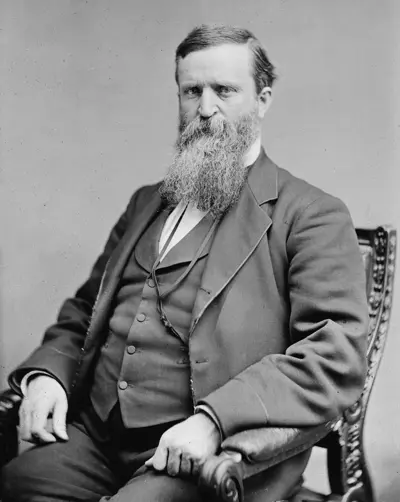
James Baird Weaver was a member of the United States House of Representatives and two-time candidate for President of the United States. Born in Ohio, he moved to Iowa as a boy when his family claimed a homestead on the frontier. He became politically active as a young man and was an advocate for farmers and laborers. He joined and quit several political parties in the furtherance of the progressive causes in which he believed. After serving in the Union Army in the American Civil War, Weaver returned to Iowa and worked for the election of Republican candidates. After several unsuccessful attempts at Republican nominations to various offices, and growing dissatisfied with the conservative wing of the party, in 1877 Weaver switched to the Greenback Party, which supported increasing the money supply and regulating big business. As a Greenbacker with Democratic support, Weaver won election to the House in 1878.
