William McKinley Quotes
Our patriotism is neither sectional nor sectarian. We may differ in our political and religious beliefs, but we are united for country. Loyalty to the government is our national creed.
The phrase “Loyalty to the government is our national creed” was advocated by almost all politicians after the Civil War. There were a few communists of the left and libertarians on the right who would disagree but every president tool this position until the administration of Ronald Reagan who then many politicians claimed that the government was a problem and even an enemy of the people. Loyalty was in their view, not to be given to the Government, but to the ideas and ideals of America (as they saw them.) Since then many politicians would talk of “loyalty to America” but not use the McKinley phrase “loyalty to the government.”
William McKinley, 1843-1901, 25th President of the United States (Republican, OH), Speech At The Catholic Summer School, Cliff Haven, New York, August 15, 1899
Sourced by: Eigen's Political and Historical Quotations


His belief is that the vast majority of Americans have a set of values in common including tolerance of alternative religions. In this sense, he considers the common values as an American Religion.


The first Native American to become a General Officer. Appointed by President Grant in 1869. When Lee arrived there were many Black troops and he mistook General Parker for a Negro but then apologized saying that “I am glad to see one real American here.” This was Parker’s reply.


“Fain” in this context means “forced by circumstances.” Emerson was suspicious of the facts behind any issue about which all are being extremely patriotic.


At the time, there was very little national news in most newspapers and almost none about local areas and peoples other than the newspaper’s town. With the exception of New York and a few other cities, there was no news on the radio and TV had not yet been deployed. Most of the nation was very insular. It would not be until the Eisenhower administration that the national highway system was built. Most American spent their entire lives within 90 miles of their home and knew little about anywhere else other than NY, Chicago, Hollywood, Washington, and San Francisco.

At the time sectionalism was extensive in America. Most Iowa and Northern families still remembered a relative who had been “killed by the rebels” in the Civil War. The South still resented the rest of the country. The East and Midwest had much better educated than the rest of the country. Most important, there was very little contact between Americans of different sections. Until the great Eisenhower initiative of a National Highway System sectionalism was common. Presidents were constantly trying to develop a national American spirit.
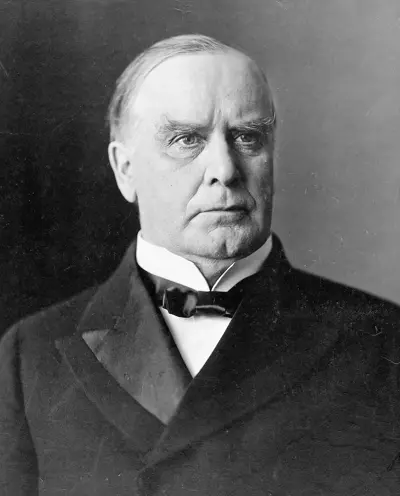
William McKinley was the 25th president of the United States, serving from 1897 until his assassination in 1901. McKinley was president during the Spanish–American War of 1898, raised protective tariffs to boost American industry, and rejected the expansionary monetary policy of free silver, keeping the nation on the gold standard.
