Winston Churchill Quotes
Our intention is, whatever happens, to fight on to the end in this Island and, provided we can get the help for which we ask, we hope to run them very close in the air battles in view of individual superiority.... In no conceivable circumstances will we consent to surrender. If members of the present administration were finished and others came in to parley amid the ruins, you must not be blind to the fact that the sole remaining bargaining counter with Germany would be the fleet, and if this country was left by the United States to its fate no one would have the right to blame those responsible if they made the best terms they could for the surviving inhabitants. Excuse me, Mr. President, putting this nightmare bluntly. Evidently I could not answer for my successors who in utter despair and helplessness might well have to accommodate themselves to the German will. However, there is happily no need at present to dwell upon such ideas.
Things were looking bleak for the British & they were dependent on material help from the U.S. to give them a chance. The British navy was one of the largest and most powerful in the world & this cable was a veiled threat that if U.S. military aid did not come, England could not defend the country in the air, Churchill might be kicked out of office & his successors surrender to Germany turning over the British fleet to Hitler giving Germany control of the seas & with their ally Japan a naval force stronger than America’s. Anglophiles would not describe it as a threat, but merely a statement of the reality of the time. Roosevelt’s Ambassador to Britain, Joseph P. Kennedy, a Nazi sympathizer & some American military officers were opposed to aid to Britain seeing it as a lost cause. Roosevelt, however, acting on his own marvelous instinct, his advice from Harry Hopkins, and his back-channel contacts in England, decided that if armed Britain could hold out. He turned out to be right.
Winston Churchill, 1874-1965, British Prime Minister (Conservative), Secret Cable to Franklin D. Roosevelt, May 20, 1940
Sourced by: Eigen's Political and Historical Quotations

This historic speech is regarded as one of the most important in Australia's history, marking a turning point in Australia's relationship with its founding country, the United Kingdom. Many felt that Prime Minister Curtin was abandoning Australia's traditional ties to the British Isles. -- Wikipedia

Hopkins was a social worker with no military of political experience. But the President trusted him implicitly. Most American military officers and Ambassador to England Joseph P. Kennedy, a Nazi sympathizer & father of JFK, believed that England could not stand up to Hitler. Any military aid we gave England would fall into the hands of the Germans. Everyone was shocked when Roosevelt sent Hopkins to England to make a military recommendation. To impress Hopkins with something he thought Hopkins would be interested in, Churchill led a tour of workers cottages built by the government. Hopkins surprised Churchill and his aids who would never forget this statement & then asked to see the military facilities. Hopkins distressed the American military by recommending that Britain could hold out against invasion if they received military aid. Despite the contrary military advice, FDR accepted Hopkins’ recommendations, and the rest is history. He had been right and much of the military wrong.

The president had wanted to send large amounts of armament and other material to England—Lend Lease—to help stave off a German invasion. The leading military men argued against it. Conservative isolationists and Congress had prevented our own military from having enough supplies and equipment. Also the conclusion of the American military leadership of the time was that England was beyond help and would have to capitulate to Germany. Even with massive armaments they would not be able to defend themselves. Any arms that we might provide to England would then fall into German hands. Roosevelt then sent his civilian assistant, Harry Hopkins, to England to assess their ability to survive. Hopkins with no military experience told Roosevelt that with the arms and ammunition England would be able to forestall invasion. Roosevelt trusted Hopkins’ judgment and decided to arm England. Hopkins turned out to be exactly correct and the military leadership was wrong. See {642830}.

He was absolutely right, but Hitler paid him no heed. See {631290} for his suggested course for Germany.

Under Truman’s leadership, the United States not only fed and clothed the victim nations of Western Europe but also did the same for the Germans. The Russians assisted the counties that they occupied and Eastern Germany but to a much lesser degree as the Russians themselves had suffered major destruction and 22 million dead in WWII. There is no case in history where a country, not only gave humanitarian aid to its defeated enemy but rebuilt their entire economy as we did for Germany, Japan and Italy at the end of WWII.

Bethe and other European refugees joined American and British scientists at Los Alamos, NM, for the development of the atomic bomb.


Precursor to CIA. WWII had begun in Europe and England was under great pressure as Hitler threatened invasion and the German military had been successful everywhere they tried to invade. FDR had received an intelligence report and advice from our Ambassador to England, Joseph P. Kennedy (JFK’s father). He told the military, the State Department, and the President that England was finished—that they would not be able to stave off the coming German invasion. He predicted that Germany would set up a puppet state. Any help America could supply would not only be wasted but if material, would fall into the hands of the Nazis and be used against us. {610109} The military attaches attached to our Embassy in England generally agreed. However, the President knew that not only did Kennedy dislike Winston Churchill {613151}, but he had been an admirer not only of German Fascism, but Hitler in particular. Kennedy ran around with some of the wealthy, aristocratic English Fascists who were advocating a negotiated surrender to prevent English civilian casualties. So FDR sent his friend, Donavan, to make an independent Assessment. Donovan had served as an officer in WWI and had earned the Medal of Honor. This quotation was the summary of Donovan’s recommendation. Based on Donovan’s report, and other information, the president had gathered and his geopolitical judgment, FDR provided aid to England (Lend Lease) and fired Kennedy, who had disliked Roosevelt before and this turned to hate and became a vendetta for Kennedy thereafter, especially when his oldest son Joe volunteered to serve in the war, that the Ambassador had so viciously opposed, {610121} and then was killed while carrying out a very dangerous volunteer mission. {616651}.

She was referring to the aftermath of the Iraq War.

Roosevelt came up with Lend Lease and other mechanisms to provide military aid to England.

The allies had differences in desirable strategy alternatives. Russia was facing the German Army on its Eastern front and causing huge German casualties but were paying for them in large loss of Russian life—civilian and military (The Russians suffered 22 million deaths as a result of WWII.) Stalin wanted to open a second front in France which would force the Germans to move some divisions from the Russian front, thereby relieving some of the pressure.

The smaller German towns had not been targets for allied bombing and German censorship kept most Germans from realizing that the factories in the larger cities were being attacked. But the “rules of war” which the Germans had abandoned early in the war by bombing civilian targets in England and other European cities, required that only military targets be attacked. If a nation placed its factories or military bases in the midst of civilian populations, then the rules of war no longer protected the civilians. So the allies were within their rights by bombing the smaller towns where they targeted factories. However, this quotation is used by some critics to show that FDR’s motive was not the destruction of factories per se, but the breaking of German civilian morale. They argue that the allies were following the letter of the law, but not the spirit.

Each day the German Airforce was sending air assaults over England. The English defenders were shooting down 2 Germans for every English plane lost. The British however were running out of pilots. Both sides were terribly weakened. However it was the Germans who cracked and called off the air assault prelude to the planned invasion of England.

Mussolini allied with Hitler. Ciano turned out to be right.

De Gaulle was a very difficult ally. He was ashamed that so many of his countrymen collaborated with the German invaders including fighting against the allies and the collapse of the French Army which, although it was larger than the German invader, had exhibited much cowardice. His way of dealing with this shame was to exaggerate the positive role that the loyal French and the serious Free French Fighters and to deny the extent of the negative behavior. He was always demanding that the small Free French Army be included in all military operations, and when successful, they be given equal credit along with the British, Americans, and Russians even though the French only contributed a tiny proportion of the effort. De Gaull’s ego, personal and national was enormous and Churchill had just as great a national ego. Hence for De Gaulle, Churchill was a kind of enemy. The “Channel” referred to the English Channel.


Germany had just attacked Russia with whom it had a treaty. For a while, Hitler paid little attention to Italy and just gave their “ally” orders and instructions. Italian public opinion was concerned about the same question. See {627973} .
In 1938 Germany had rearmed and resumed its aggressive designs of expansion. Hitler wanted the Sudetenland part of Czechoslovakia and threatened an invasion of that country. England had France had a treaty obligation to militarily support Czechoslovakia if it were attacked. British Prime minister Neville Chamberlain and the French were desperately trying to avoid war, not realizing that with Hitler, that position was the very thing that would bring on war. So they agreed to Hitler’s demand and allowed Czechoslovakia to be partitioned and the Sudetenland was annexed to Germany. This craven appeasement emboldened Hitler who then decided to conquer all of Europe as he had no serious opposition from France and England—the two powers that might have stopped him. (At the time, the French had a larger army than the Germans.)
This was just a month after the Japanese sneak attack on Pearl Harbor. Anyone at that time, who promised to attack Japan would get a serious hearing, and Chiang Kai-shek and the China Lobby were making extraordinary promises. FDR wanted to give Chiang’s Nationalist government an extraordinary $½ Billion in aid. One interesting aspect of this quotation is the wording. Note that the President used the word “invent”. He realized that there was no existing mechanism whereby they could simply send such a huge block of money to a foreign country on the promise that they would use it for fighting the Japanese. If there were, he would have had the War Department or the State Department to do it. So he asked his most trusted and creative cabinet member to “invent” a way to do it. Morgenthau came through with a very complicated, elaborate scheme that Congress approved the following week. The money was sent, but Chiang Kai-shek did not spend it all for fighting the Japanese—his idea was to let the Chinese Communists under Mao wear themselves down fighting the Japanese, and Chiang could use the American military assets to then wipe out the communists, his only political opponents. See {641676}.
The last phrase was a variation of the famous Bismarck quotation {594849}.
At Hamburg Harris organized a massive fire bombing of the German industrial city and the fire storm was so great that it sucked the oxygen out from huge sections of the city and thousands of people were roasted alive. Even with 100,000 Germans killed, Harris was convinced that it was a relatively humane way of waging a necessary war when compared to the classic artillery barrage followed by invading soldiers and street to street fighting.

First edition typo error -- dropped: "differences to a decision of them by an appeal to arms; to exclude foreign" Smith had written to most of the then likely Presidential candidates of both major parties asking for their position on the Mormons who were facing persecution wherever they went. None of the politicians would make any satisfactory commitments. Smith took Direct Action and became the only major religious official to have run for the Presidency of the United States until Pat Robertson tried and failed in 2000. Smith’s assassination shortly thereafter cut his run for the Presidency short before it made much headway and politically he had no chance to affect the race. In this platform he quoted and gave credit to Madison for many of the ideas.
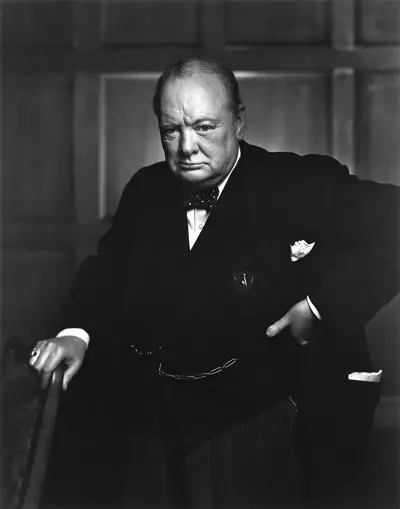
Sir Winston Leonard Spencer Churchill, KG, OM, CH, TD, DL, FRS, RA was the Prime Minister of the United Kingdom from 1940 to 1945, during the Second World War, and again from 1951 to 1955. Apart from two years between 1922 and 1924, Churchill was a Member of Parliament (MP) from 1900 to 1964 and represented a total of five constituencies. Ideologically an economic liberal and imperialist, he was for most of his career a member of the Conservative Party, as leader from 1940 to 1955. He was a member of the Liberal Party from 1904 to 1924. Churchill was also well known for his military career and as a historian, painter and writer, and among his many awards was the Nobel Prize in Literature.
