Scott Gottlieb Quotes
Our Founders thought politicians should be accountable when it comes to citizens' right to life, liberty and the pursuit of heart surgery.
Gottlieb, Scott. "The Founders and Health Care." The Wall Street Journal, 2009.

He had been a Congressman before assuming the Presidency. Civil rights was a major subject of debate after the Civil War. One major issue was that of citizenship itself. Many contended that Americans were citizens of a state and dependant on the state for the protection of civil rights. However, the extent to which the Federal government could and should be the guarantor of citizenship issues was in dispute. Today with the issue settled in favor of Federal preeminence, it is hard to realize that this was very unsettled at one point in history. Garfield was one of those leading the effort for more Federal involvement and control.


See {587703} for a similar statement by a Supreme Court Justice.

This statement summarized what had been a basic principle of American Law as derived from English law. See {587704}.


He was subpoenaed by the House Un-American Activities Committee where he was accused of being a Communist which he eloquently denied starting with this statement. He died of a heart attack 3 days later. However, most historians agree that White passed classified information to the Russians. He was accused of being a Communist, but there was never any evidence of that. Some people believe that he was a spy for the Russians and committed espionage, but others disagree observing that White was very much his own man and felt that much information that was classified never should have been. White substituted his own judgment, it is believed, about what could be given to the Russians for the security system. He was an admirer of what Russian socialism had accomplished economically, educationally and medically since the 1917 revolution deposing the Czar. Russia had been a valuable military ally, which had taken the brunt of both military and civilian casualties in WWII. White’s economics were certainly not Marxist but very much Keynesian.


Agnes Gonxha Bojaxhui

The call for individual liberty and the right of personal property by clergy is surprising to many. This Cahier was the consensus of the Clergy of Blois in 1789. There were cahiers of several provinces of France—some by the clergy, some by the nobles. What is fascinating is the emergence of many of the pre-Revolutionary French concepts. The example of the American revolution and its principles was known throughout the educated classes of France.


It was drafted by John Adams. 9 Years later the French in their Revolution used the first clause in their Declaration of the Rights of Man and of the Citizen—See Quotation 602404 For an opposite point of view see Quotation 635927.

This constitution, 13 years later, became the basis for the national Batavian Constitution.

He had and has since accepted awards and honors from professional organizations who honor their colleagues for their accomplishments. However, he objected to government granting honors in fields where a government was not competent, and worse, it harkened back to the nobility and titles of Europe before democracy. In his view, it is the people who should judge the government’s achievement and competence and not the other way around which he believes is fundamentally undemocratic. In America, although we hate titles, we have many honors bestowed on civilians by government. The Medal of Freedom for example and the Medals the government gives for nuclear and other science achievements.


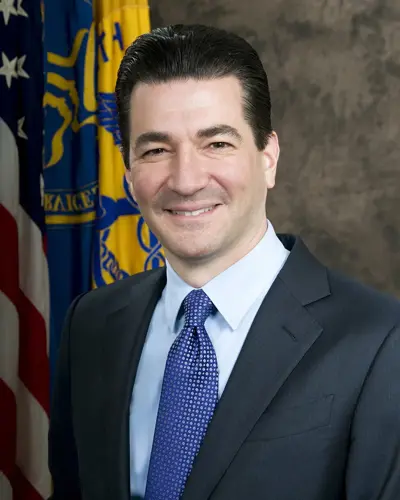
Scott Gottlieb is an American physician and investor who served as the 23rd commissioner of the Food and Drug Administration (FDA) from 2017 until April 2019. He is presently a resident fellow at the conservative think tank the American Enterprise Institute (AEI), a partner at the venture capital firm New Enterprise Associates (NEA), a member of the board of directors of drug maker Pfizer, Inc, a member of the board of directors of Illumina, Inc., and a contributor to the cable financial news network CNBC. Before becoming FDA commissioner, he was a clinical assistant professor at New York University School of Medicine, the FDA deputy commissioner for medical and scientific affairs, a venture partner with New Enterprise Associates, a member of the policy board of the Leukemia & Lymphoma Society, a senior official at the Centers for Medicare and Medicaid Services, and a member of the Federal Health Information Technology Policy Committee, which advises the United States Department of Health and Human Services on healthcare information technology. He was previously a resident fellow at AEI from 2007 to 2017 prior to joining the FDA as commissioner in May 2017.
