Mark Twain Quotes
Our Civil War was a blot on our history, but not as great a blot as the buying and selling of Negro souls.
Samuel Langhorne Clemens, 1835-1910
Mark Twain, Writer, Founder, Anti-Imperialist League, Quoted in Clara Clemens Gabrilowitsch, letter to The New York Herald Tribune, November 19, 1941
Sourced by: Eigen's Political and Historical Quotations


The general issued a military order emancipating slaves in Florida, Georgia and South Carolina. President Abraham Lincoln rescinded the order feeling it was too premature and it would cause the slave states that stayed in the Union--Delaware, Maryland, and Kentucky--to go over to the Confederates.


This was not an original notion with Abraham Lincoln. Seward and most of the “Radical Republicans” believed that the slavery issue had to be resolved and attempts to compromise were futile.

Essentially, the case of moral hazard was made against paying the slave owners. Lincoln took a pragmatic approach. However, not only was Northern opposition too strong for this proposal, but the Southern slave holders would never agree to selling their slaves. What Lincoln and most “pragmatic” Northerners did not realize is that even if the slave owners would get a fair market price for the slaves, they would be left with land and no way to work it. Their families would have no servants. They might have to work themselves like Northern farmers did, and their entire standard and style of living would be destroyed. Their sons were not well educated as many Northern young men were and were brought up to be gentlemen, politicians, and occasional soldiers—not work with their hands. They could not compete. And the slaveholders were right as the whole history of Reconstruction and backwardness demonstrated for more than 100 years.


Marx followed the American Civil War very closely. The freeing of the slaves caused an immediate social, moral and economic revolution, the results of which we live with today.


Buchanan us considered by most historians to have been the worst or one of the worst Presidents of the United States. At this point, he was a lame duck president with Abraham Lincoln, the President Elect soon to take office. This speech, just encouraged the South more than ever and helped to bring about the Civil War. His vacillation and lack of any leadership on the slavery question exacerbated the polarization that was tearing the nation apart.

Phelps was a Copperhead Democrat who was a virulent racist, an enemy of Lincoln and supported McClellan against Lincoln in 1864. His extreme disrespect for the President and his racism was not appreciated in Vermont, and Phelps not only failed to help McClellan but destroyed his own credibility in his home state of Vermont. Phelps had been practicing law in New York City where there was a large Copperhead, racist and anti-Lincoln part of the population there.

Some Southerners, in order to obtain support in England for the Confederate cause claimed in their propaganda that slavery was not the issue but their issue with the Union was just one of local and regional autonomy. The British and most Europeans at that time were strongly against slavery so this “spin” might have gotten some support. Stowe and others put the lie to this, and the Confederacy never did get any significant material support from any country in Europe. The secession resolutions of the Southern States all state that Slavery was the cause (and often the ONLY cause stated) of secession. Also Southern General Mosby, called the spin for what it was. See {584991}.

At this point, there had hardly been any fighting and no outrages or war crimes were yet committed by either side. These would come later—more on the Confederate side as they did not want to take the limited resources they had from their troops to fulfil abstract obligations to prisoners of war or to civilians. A few deliberately chose to use terror tactics. The Union troops also at various points in the war got out of hand and looted personal property of civilians. But at this point, this proclamation was just lies and propaganda.
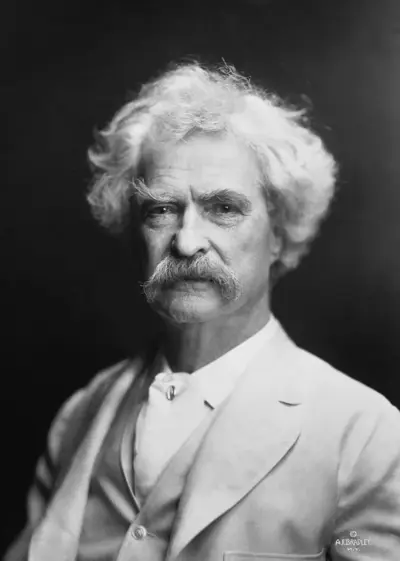
Samuel Langhorne Clemens, known by his pen name Mark Twain, was an American writer, humorist, entrepreneur, publisher, and lecturer. He was lauded as the "greatest humorist the United States has produced," and William Faulkner called him "the father of American literature". His novels include The Adventures of Tom Sawyer (1876) and its sequel, the Adventures of Huckleberry Finn (1884), the latter often called "The Great American Novel".
