Joseph Dietzgen Quotes
The institution of slavery in U. S. A. was Christian, and Christianity was slave-holding there.
Joseph Dietzgen, 1828-1888, German Political Philosopher, Scientific Socialism, 1873
Sourced by: Eigen's Political and Historical Quotations

This title of his essay shocked his fellow politicians and may churches that a Congressman would attack churches. Few abolitionists were that outspoken over the disgraceful role that most American Churches had in refraining to oppose slavery. At the time, most Protestant, Roman Catholic, and Jewish clerics either supported slavery or were reluctant to publicly criticize slavery. At the same time the Quakers and many other congregations and clergymen were among the most outspoken and fervent abolitionists. They were very much in the minority,


Brown was the richest man in Rhode Island and made much of his money in the slave trade. This quotation shows that slavery was not completely a North verses South split. Northerners like Brown for whose family Brown University was named, was as virulent supporter of slavery as the most ardent Southerner.


[This was the first Abolition appeal written by a Black Man. It was published in Boston and despite the fact that it was very critical of whites, was very popular going through two more printings within the next two years.]

This moral statement from a New jersey Quaker abolitionist is not particularly noteworthy, However what makes this quote important is that Woolman traveled throughout the South preaching this as his main theme. At that time — before the American Revolution — he did so and was not attacked or intimidated; he was mostly ignored by the Southern authorities. At the time, the South was very confident of its ability to continue slavery. Years later, when the abolition movement grew larger and stronger, a Northern Quaker Preacher doing this not not escape with his life.

In the first part of the 18th Century, one county in Virginia became a magnet for runaway indentured servants, The more runaways settled there the more empathetic and hospitable they were to new runaway servants. The culture at the time had identified knowing your place in society and accepting it. So a runaway indentured servant had renounced their oath and contrast to serve their masters, and hence were not Christians. These renegades were armed and there was not enough political will or support for forcing the County to comply with the laws and mores of the time.


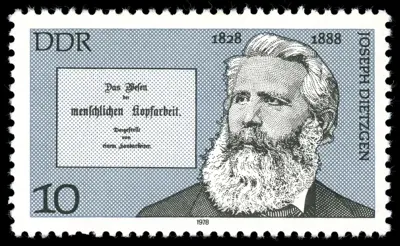
Peter Josef Dietzgen was a German socialist philosopher, Marxist and journalist. Joseph was born in Blankenberg in the Rhine Province of Prussia. He was the first of five children of father Johann Gottfried Anno Dietzgen (1794–1887) and mother Anna Margaretha Lückerath (1808–1881). He was, like his father, a tanner by profession; inheriting his uncle's business in Siegburg. Entirely self-educated, he developed the notion of dialectical materialism independently from Marx and Engels as an independent philosopher of socialist theory. He had one son, Eugene Dietzgen.
