Woodrow Wilson Quotes
No nation is fit to sit in judgment upon any other nation.
American Presidents after Wilson have not, in general, shared this view. By the latter part of the 20th century judgmentalism was a major component of American foreign policy and reached its zenith with the administration of George W. Bush.
Woodrow Wilson, 1856-1924, 28th President of the United States (Democrat, NJ), Speech 1915
Sourced by: Eigen's Political and Historical Quotations


See Carl Schurz {33636} for an 1872 version and G. K Chesterton for perspective {597471}.


When whites first came to America, the Iroquois, were the most sophisticated Native Americans. They were actually a confederation of 5 different tribes each of which was composed if many clans. Although fierce warriors, they had agreed not to fight each other and to assist if any were attacked. They developed a strong agricultural base, to go with the fishing and hunting, and their confederation were very aggressive and sophisticated traders taking them far from their upstate New York “capitol.” Their governmental structure was quite sophisticated with an elaborate, formal, system of checks and balances, multi-cameral legislatures that recognized numbers of citizens, power and wealth, and even cultural traditions. They were literate, capitalistic and globalistic in that they wanted to trade with all. They had written laws, and women had a role that was unique in world history in that only women owned property in a matrilineal society. Further, it was only the Clan Mothers who voted for the 50 Sachems (~Senators)—but their selections had to be accepted by the people they represented. Ironically the descendants of the Iroquois who remained in New York became a very successful Native American group. In the 2000 census, the average Indian in New York State earned the same income as the average White with no Indian gambling money.

This was the time of the rise of Hitler and efforts of communist revolutionary activity alike.


Eisenhower was clear on this point but the neoconservatives of the Republican party advocated just the opposite and decades later would influence American foreign policy to have a different view and aggressively export American democracy as in the Iraq War.

This quotation is an excellent example of a kind of political statement that sounds terrific at first, but when you think about it, it is hard to determine what it means. It is clearly some kind of criticism of international and multinational organizations but it is impossible to know what the candidate is proposing. He does not urge that the US not participate in the multilateral organizations? He warns that when we do participate, we should not cede our moral authority to them. But no one can determine had a sovereign nation like the United State cedes any moral or other kind of authority by participating in these organizations.
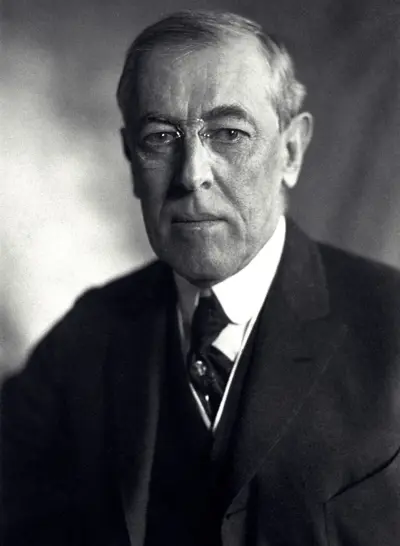
Thomas Woodrow Wilson was an American politician and academic who served as the 28th president of the United States from 1913 to 1921. A member of the Democratic Party, Wilson served as the president of Princeton University and as the 34th governor of New Jersey before winning the 1912 presidential election. As President, Wilson led the United States into World War I in 1917. He was the leading architect of the League of Nations, and his progressive stance on foreign policy came to be known as Wilsonianism. Scholars have generally ranked Wilson in the upper tier of U.S presidents, although he has been criticized for supporting racial segregation and white supremacy.
