Dwight D. Eisenhower Quotes
Honoring the identity and the special heritage of each nation in the world, we shall never use our strength to try to impress upon another people our own cherished political and economic institutions.
Eisenhower was clear on this point but the neoconservatives of the Republican party advocated just the opposite and decades later would influence American foreign policy to have a different view and aggressively export American democracy as in the Iraq War.
Dwight D. Eisenhower, 1890-1969, 34th President of the United States (Republican, KS), First Inaugural Address, January 29, 1953
Sourced by: Eigen's Political and Historical Quotations

India had just recently gained its independence from Britain.


This was his signal for a reversal of policy from the 4 previous American Presidents of vigorously exporting Democracy and repect for Human Rights for women as well as men. Trump restricted his foreign policy to teh immeidate economic and security interests of the United States. This reversal, was opposed by many including most Republican politicans and activists for whom the spread of true democracy and human rights had been a cornerstone of their foreign policy for years. However, it was very popular amongst American isolationists, and other Republicans and Democrats as well who did not want to focus American lives or treasure on foreign nations whose cultures and history were anti-democratic and had little respect for women or human rights.


American Presidents after Wilson have not, in general, shared this view. By the latter part of the 20th century judgmentalism was a major component of American foreign policy and reached its zenith with the administration of George W. Bush.

When whites first came to America, the Iroquois, were the most sophisticated Native Americans. They were actually a confederation of 5 different tribes each of which was composed if many clans. Although fierce warriors, they had agreed not to fight each other and to assist if any were attacked. They developed a strong agricultural base, to go with the fishing and hunting, and their confederation were very aggressive and sophisticated traders taking them far from their upstate New York “capitol.” Their governmental structure was quite sophisticated with an elaborate, formal, system of checks and balances, multi-cameral legislatures that recognized numbers of citizens, power and wealth, and even cultural traditions. They were literate, capitalistic and globalistic in that they wanted to trade with all. They had written laws, and women had a role that was unique in world history in that only women owned property in a matrilineal society. Further, it was only the Clan Mothers who voted for the 50 Sachems (~Senators)—but their selections had to be accepted by the people they represented. Ironically the descendants of the Iroquois who remained in New York became a very successful Native American group. In the 2000 census, the average Indian in New York State earned the same income as the average White with no Indian gambling money.

Actually drafted by Secretary of State, John Foster Dulles

The American concepts of democracy and human rights have been resented when U. S. policy advocated other nation’s adhering to them.
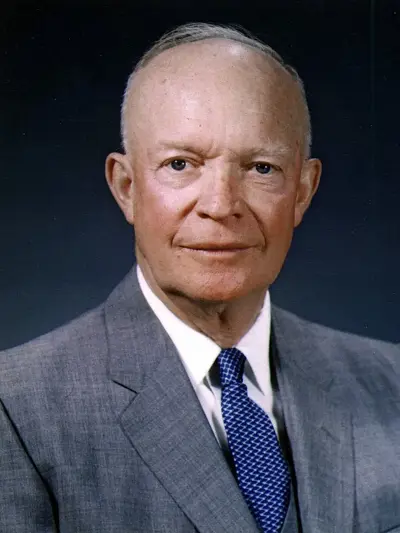
Dwight David "Ike" Eisenhower GCB OM GCS CCLH KC NPk was an American military officer and statesman who served as the 34th president of the United States from 1953 to 1961. During World War II, he became a five-star general in the Army and served as Supreme Commander of the Allied Expeditionary Force in Europe. He was responsible for planning and supervising the invasion of North Africa in Operation Torch in 1942–43 and the successful invasion of Normandy in 1944–45 from the Western Front.
