Theodore Roosevelt Quotes
Most of these people habitually led rather gray lives. And they came to see the president much as they would have come to see the circus. It was something to talk over and remember and tell their children about. But I think that besides the mere curiosity there was good feeling behind it all, a feeling that the president was their man and symbolized their government, and that they had a proprietary interest in him and wished to see him and that they hoped he embodied their aspirations and their best thoughts.
Theodore Roosevelt, 1858-1919, 26th President of the United States (Republican, NY), Written reflections on the large crowds that had come to see him on a trip to the West, Quoted in David Greenberg, “Beyond the Bully Pulpit”, The Wilson Quarterly, September 2011
Sourced by: Eigen's Political and Historical Quotations


Samuel Langhorne Clemens, 1835-1910

See {640102} and {640101} for his view of what a nation is not.

The only soldier ever so honored. At the beginning of WWII, President Roosevelt and Churchill wanted the U. S. Army to invade German and Italian North Africa. Marshall, General Eisenhower, and all the other military men, advised that while it was possible, it would be a diversion from the strategic objective of invading Europe. None the less FDR ordered the invasion. The effect on the American people was wonderful, It showed that the Germans were not invincible, increased enlistment and morale at home, and developed more popular support for the war. Later, Marshall learned much about Democratic leadership and he, himself became a very effective government leader, and began to appreciate FDR’s approach but with a little cynicism about democracy.


In 2016 there was a military coup and Erdogan was in danger of losing control and beoing ousted. However, he made this plea to his supporters amont the citizenry, and they, including many from the military, put down the coup.


Churchill and the British Military wanted to start the offensive against Hitler by attacking and dislodging the Germans and Italians in North Africa and then attacking Italy before attacking France. The American military Generals wanted to attack France first and did not want an African campaign to divert from the main objective. However, France would take much longer to prepare for, and Americans were very anxious to have our forces go on the offensive. Roosevelt overruled the Generals and sided with Churchill also arguing that rolling up some victories in North Africa would be good for American morale and give us more time to produce more tanks, plans and other munitions which were then rolling off the assembly lines and an incredible clip. Churchill also advised that American troops were green and Africa would be good preparation. It turned out that this was the better course of action.


At the time, there was very little national news in most newspapers and almost none about local areas and peoples other than the newspaper’s town. With the exception of New York and a few other cities, there was no news on the radio and TV had not yet been deployed. Most of the nation was very insular. It would not be until the Eisenhower administration that the national highway system was built. Most American spent their entire lives within 90 miles of their home and knew little about anywhere else other than NY, Chicago, Hollywood, Washington, and San Francisco.


He had been the President of the Soviet Union which was all of a sudden 15 different nations. He resigned immediately.


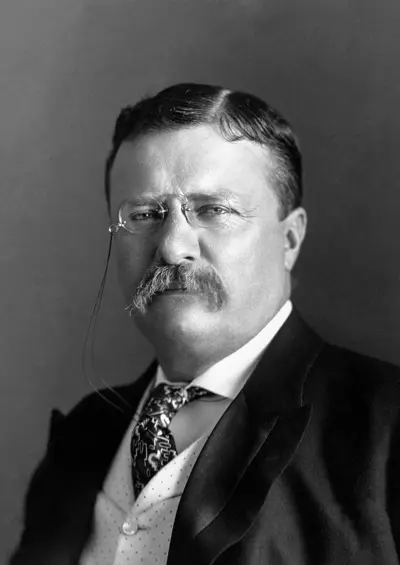
Theodore Roosevelt Jr., often referred to as Teddy or his initials T. R., was an American statesman, conservationist, naturalist, historian, and writer, who served as the 26th president of the United States from 1901 to 1909. He previously served as 33rd governor of New York from 1899 to 1900 and the 25th vice president of the United States from March to September 1901. Roosevelt emerged as a leader of the Republican Party and became a driving force for anti-trust and Progressive policies.
