Gertrude Stein Quotes
Money is always there but the pockets change; it is not in the same pockets after a change, and that is all there is to say about money.
Stein, Gertrude. Everybody's Autobiography. Random House, 1937.


Most people owned a little land as most of America were still farmers. They had small amounts of money at different times but spent it for necessities. A relatively few people (mostly in the East) had money—gold and paper currency backed by gold. If the price of property was high, only rich could afford to buy it. The home mortgage system did not then exist, so there was no way that the average land owner could get enough money to buy land to expand farms or buy for children unless the price was low. Today, most land owners want the price of land to be high. The financial system in use at the time makes the difference.


At the time, there was no United States currency. Private banks in some of the states issued their own money. A dollar from Georgia might only be worth 75 cents in New York.

The majority of the Supreme Court has voted 5-4 that a corporation cannot be limited in the amount of money it spends on an election campaign as curtailing the money that is spend is tantamount to curtailing the amount of speech and spending money to elect a candidate is a form of political speech. Stevens made a major distinction between money and speech and challenged the logic that conflated the two. The nation was polarized on this issue, with liberals and conservatives on both sides of the question.


The sense of the word affair is the general purpose, and Smith was referring to the fact when he investigated any proposed or implemented public scheme or law, there was an objective of someone obtaining money as a consequence. As journalists say in covering politics, “follow the money.”


This is the first major history of banks written in the United States.

Harvey was one of those who argued that silver and not gold should be the basis of American money. The country was growing and the amount of gold was relatively fixed; therefore money was scarce and many believed the English and American financiers were hording gold deliberately. The final solution was not a gold standard or a silver standard but what we have today—a currency backed only by the full faith and credit of the U. S.


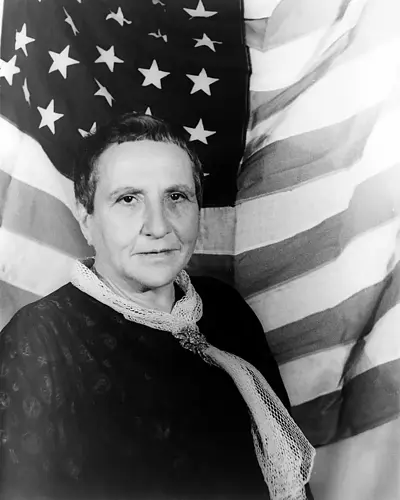
Gertrude Stein was an American novelist, poet, playwright, and art collector. Born in Pittsburgh, Pennsylvania in the Allegheny West neighborhood and raised in Oakland, California, Stein moved to Paris in 1903, and made France her home for the remainder of her life. She hosted a Paris salon, where the leading figures of modernism in literature and art, such as Pablo Picasso, Ernest Hemingway, F. Scott Fitzgerald, Sinclair Lewis, Ezra Pound, Sherwood Anderson and Henri Matisse, would meet.
