Mao Zedong Quotes
Liberalism is extremely harmful in a revolutionary collective. It is a corrosive which eats away unity, undermines cohesion, causes apathy and creates dissension. It robs the revolutionary ranks of compact organization and strict discipline, prevents policies from being carried through and alienates the Party organizations from the masses which the Party leads. It is an extremely bad tendency.
This is a very noteworthy quotation. The reason is that in America, the extreme right wing accuses liberals of being communists or supporters of communism. However, here one of the two major Communists in the world, condemns liberalism and states that liberals are the enemy of communism.
Mao Tse-Tung, 1893-1976, Chairman, Communist Party of China, Chinese Revolutionary Leader & Political Philosopher, Founder, The People’s Republic of China, "Combat Liberalism", September 7, 1937
Sourced by: Eigen's Political and Historical Quotations


“Liberalism” was a catch all Chinese term at the time which was very derogatory in Communist vernacular very much like the negative connotation of liberalism to American Conservatives at the turn of the millennium 1990-2010.
“Liberalism” was a catch all Chinese term at the time which was very derogatory in Communist vernacular very much like the negative connotation of liberalism to American Conservatives at the turn of the millennium 1990-2010.


“Liberalism” was a catch all Chinese term at the time which was very derogatory in Communist vernacular very much like the negative connotation of liberalism to American Conservatives at the turn of the millennium 1990-2010.


Fascists organized their political parties as paramilitary organizations.


Seeger’s admission was typical of tens of thousands of Americans who had become disillusioned with the fairness, equity, and effectiveness of capitalism during the depression. They were easy prey for Communist propaganda which pointed out all the problems in American society from legal racial discrimination to lack of a social safety net while at the same time lying about the Russian achievements and hiding the horrible abuses of human rights—especially the political murders of millions of people. Then the truth about Russia emerged, Seeger and so many others abandoned the Communist Party as at the same time America was improving its society and beginning to try and deal with the great problem that had plagued America from its inception—racism and slavery.

This is one of the most indelicate political statements ever made. Normally, the argument that communists should be murdered is incendiary enough, but this remark came shortly after the Arizona attempted assassination of Congresswoman Gabrielle Giffords where she was shot in the head.

Rival to Mao. This quotation is historically important because it shows how intensively the Chinese Communists concentrated on organizing the fringe and unpopular groups of society to the point where the struggle was between Chiang Kai-shek’s Nationalists and everybody else. The Chinese Communist coalition included many who had not idea of what communism was but knew that Chiang Kai-shek and the Nationalists were not very good for them or the people they knew.

It is hard to believe that anyone who could write this, would end up running the largest society since the middle ages where total conformity was required with death often accompanying dissent. Yet that is exactly what happened in this great intellectual and philosophical flip flops.

Vladimir Lenin. Most did not and the Communist government was brutal and murderous in forcing them into the Communist culture, outlook, and behavior. See {640096} for a description of some of the effort.


This principle represented one of the rifts between Gorter and Lenin. Lenin and most Russian Communists insisted that labor unions be subservient to the Communist Party and the State. Gorter, and a few other socialists argued for the independence of the unions from the control of all but its membership. Unions subservient to political parties have been disastrous in some of the Communist countries but also in the Fascist nations where the right wing took over control of the unions. Even in America, the Communist Party attempted to take over the unions in the first half of the 20th century and actually succeeded in a few cases. Those opposing unions of any kind saw little difference between the unions and the Communist Party. Some American unions came under the control of the communists and others under the control of the companies, but most have been independent.
Many Communist Party officials saw the red army as only a fighting unit. Mao had a larger vision and that vision contributed greatly to the success of the communist revolution. However, long after the revolution the Red Army, even into the 21st century, was so involved with affairs at all levels it was an economic, intellectual and political force of its own.
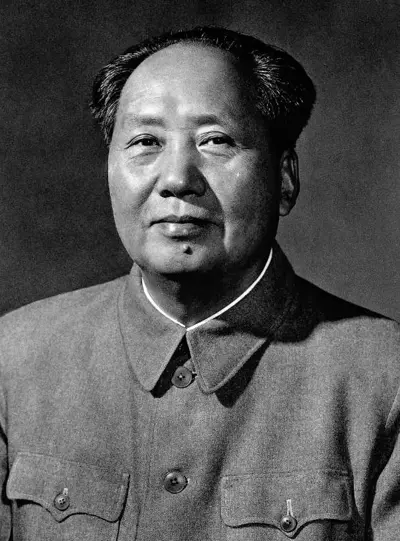
Mao Zedong, also known as Chairman Mao, was a Chinese communist revolutionary who was the founder of the People's Republic of China (PRC), which he ruled as the chairman of the Chinese Communist Party from its establishment in 1949 until his death in 1976. Ideologically a Marxist–Leninist, his theories, military strategies, and political policies are collectively known as Maoism.
