Mao Zedong Quotes
“You are dictatorial.” My dear sirs, you are right, that is just what we are. All the experience the Chinese people have accumulated through several decades teaches us to enforce the people's democratic dictatorship, that is, to deprive the reactionaries of the right to speak and let the people alone have that right.
Mao Tse-Tung, 1893-1976, Chairman, Communist Party of China, speech commemorating the 28th anniversary of the Chinese Communist Party, 30 June 1949.


The early revolutionary Chinese Communists had a much more democratic and civil-liberties oriented view of government than after the had won and gained control of China. Then the problems were so enormous with such meager resources that the insecurity of the party government let to a civil rights flip flop and a politically authoritarian government. Stability is today the most important priority for the Chinese Communist party so that free speech, protests and other civil liberties are curtailed. Economic development is the more important activity and political development is lagging, but while economic development is racing ahead, Chinese political development improves only slowly. Dissidents like Liu Xiaobo are pushing the process.

To modern Americans, this quotation is shocking. The thought that the United States Army could publish such a statement is hardly believable. Many first reactions assume that there was some mid level fascist officer in a training department which issued it. However this was not the case. It was issued in the name of the Secretary of War under the signature of Generals C.P. Summerall and Lutz Wahl, Chief of Staff and Adjutant General respectively. This document and others like it together with the views of pro fascist Americans like Henry Ford convinced Hitler and other European fascist leaders that America would not interfere with their designs on Europe.

They were very much influenced by the American Declaration of Independence and Tom Paine’s writings. The graphic is one of Rembrandt’s famous painting of a voluntary militia corps.


Referring to the Erdogan government of Turkey. That country elected Erdogan who then turned his back on the Ataturk inspired democracy and instituted many non-democratic policies and practices including jailing civil servants, teachers and journalists who publicly criticize the president or the government.


Vladimir Lenin. The two American leftists had been deported from America. Lenin and the Russian leadership was delighted to have these two famous radicals, and they thought they would find Russia wonderful. But soon the Americans discovered that the freedoms that they found so critical did not, and would not, exist in Communist Russia. After two years, they left Russia for Canada and Europe where they wrote and castigated Communist Russia to the delight of their old American enemies and the shock of many of their old American friends. Lenin was glad to be rid of them. They were as much of a threat to his regime as they were to the United States of the time.

This seemingly logical inconsistency is actually typical of many nations and cultures that practice censorship. Freedom in this is a concept of a limited freedom—limited to what is reasonable, not harmful, not offensive. So all are free to behave within a circumscribed set of norms. By this logic, freedom is not being curtailed if the state acts to stop activity beyond those norms. Every nation accepts this principle to some extent. In America one “cannot should fire in a crowded theater” but there are very few other restrictions. But in Germany, Israel and other modern Industrial democracies there is censorship of material that promotes ethnic hatred whereas in the U. S. that is protected from censorship. In China many sites on the Internet have material that is regarded as inflammatory, or slanders the government and this is bad because people might lose confidence in their government. So freedom of speech and censorship issues are matters of degree with the United State being at one end of the scale and North Korea and Saudi Arabia being at the other end. China has been moving from the North Korean end of the scale towards the middle.


The Masses was a left wing publication which the then Post Office officials decided were “dangerous”. Later, the Supreme Court would hold that there could not be this degree of political censorship by Post Office officials.


This was a description of the post WWII censorship in East Germany under the communists, but it applies to most political censorship in any country. The same dynamics functioned in the United States during both World Wars and during the red scare of McCarthyism.
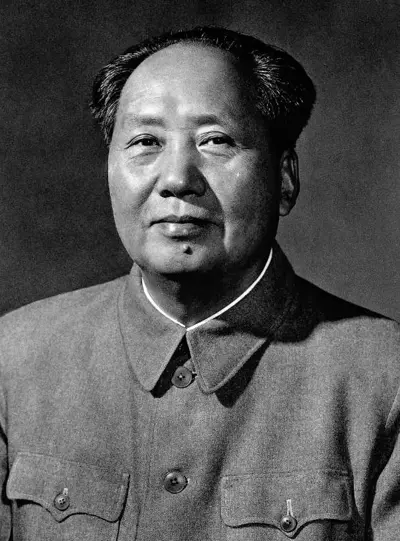
Mao Zedong, also known as Chairman Mao, was a Chinese communist revolutionary who was the founder of the People's Republic of China (PRC), which he ruled as the chairman of the Chinese Communist Party from its establishment in 1949 until his death in 1976. Ideologically a Marxist–Leninist, his theories, military strategies, and political policies are collectively known as Maoism.
