John Dewey Quotes
Legislation is a matter of more or less intelligent improvisation aiming at palliating conditions by means of patchwork policies.
John Dewey, 1859-1952, Philosopher & Educator, The American Background, Freedom and Culture, 1939
Sourced by: Eigen's Political and Historical Quotations

He was discussing “Stand Your Ground Laws” which were enacted to solve one problem, but then effected many other things negatively. The law, once passed, is the law regardless of whether it has adverse consequences that the legislators never anticipated. This is one of the reasons that drafting legislation is such a difficult skill.


Davis was trying to get the Black Caucus to adopt a unified program to advocate more Civil Rights and not concentrate on individual personalities.


This is a very important historical and political quotation. The first clause shows us that earmarks and private bills for the benefit of individuals and their commercial enterprises are not a new form of corruption; they have existed ever since there have been legislatures.
The most important aspect of this quotation is the SECOND clause. Very frequently, this is quoted alone without the context of the first clause. Taken alone, the meaning seems to be that the more corrupt governments pass the most laws, and there is an implication that fewer laws mean less corruption. This interpretation fits perfectly with the conservative ideology of the late 20th and early 21st centuries that believed that the smaller the government, the better; the fewer the laws passed, the better. However with the context of the first clause, we see that what Tacitus was criticizing the legislature that passed many earmarks and bills benefitting special interests. The more of these that were passed, the more corruption he argued. So he did not object to laws per se. He was not opining on the relationship between the number of laws and a corrupt government if the laws are for general benefit and not for special interests. Out of context, it might appear that Tacitus was supporting the small government, conservative philosophy. In context, he is arguing against earmarks and special interest legislation and supports what we call “good government” which has been bipartisan in America with parts of each party agreeing with Tacitus and other parts of each party trying to pass earmarks and special interest legislation.


Note his choice of the word “control”. Some politicians believe that the purpose of most legislation is to enhance the control; that the government maintains over its citizens. However the United States Constitution was written and ratified so that the citizens could control the politicians. Neither group has prevailed totally.
See {630440} for an earlier English human relations statement of the idea.

The Social Security law, most American’s favorite government program, had just been passed that year, and like the Affordable Health Care Act in the Obama administration, the Republicans were rabidly opposed to the program, and there was none of the collaboration with an objective to perfect and improve the legislative language. And like “Obama Care” and most very large new government initiatives, there were many problems that became clear once the program was started. Amazingly President Roosevelt was the first to tell the public and the press that the Social Security program will have many problems, but what does not work can be replaced by something else and the program would be improved. This was part of FDR’s basic approach to the Presidency. (See {631419}.) No politician in modern times would be able to say that or anything like it, and Mrs. Roosevelt’s quotation here, which she wrote for the entire country to see, most politicians and political scientists would agree that she was exactly right about new legislative initiative.

America’s first political economist

When questioning Equifax CEO Richard Smith at hearing following a major secruity breach of customer data at the company.


Johnson had proposed an extremely strong civil rights bill. Most Washington insiders assumed that he would gain favor amongst fair minded whites and Blacks for making the attempt, but then he would compromise with the Southerners, and water down the bill to something that had little or no teeth. His staff were trying to learn from Johnson, which aspects of the bill he was willing to compromise on assuming that the President could never get Congress to pass the bill in its original form. They were really surprised at the President’s answer and assumed that he could not do it. They were more surprised when he did drive the bill through Congress without any substantive compromises. It was the most powerful and effective Civil Rights legislation passed since Reconstruction a century earlier.
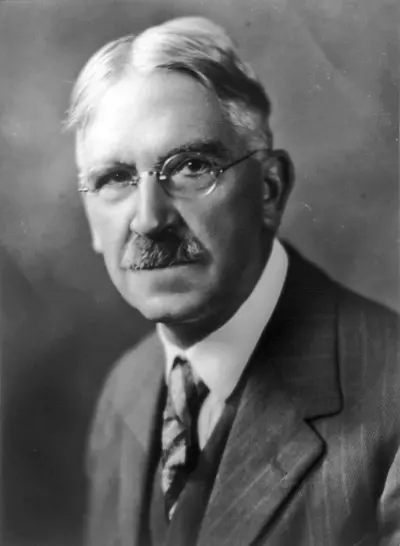
John Dewey was an American philosopher, psychologist, and educational reformer whose ideas have been influential in education and social reform. He was one of the most prominent American scholars in the first half of the twentieth century.
