Winston Churchill Quotes
It may well be that we shall by a process of sublime irony have reached a state in this story where safety will be the sturdy child of terror, and survival the twin brother of annihilation.
Churchill, Winston. Hansard, House of Commons, 1 Mar. 1955, col. 1899.


Shelly was a reformer and admired Jesus Christ and his preaching. However, he was an opponent of organized religion and was an atheist himself.

The atomic bomb had just been used the year before. However, in the next decades, nuclear weapons were not used again as those nations with nuclear capability also had potential enemies with nuclear weapons. The fear of Mutually Assured Destruction prevented nuclear weapons from being used for a long time.


The Scientific Project that developed the Atomic Bomb. After the development of the atomic bomb there were great pressures on the involved scientists to downplay the dangers of nuclear weapons development. The weapons developer arm of the government was anxious not to frighten the public which might call for more oversight or even limitation of development and testing. Equally important was the scientists themselves who understood the forces that they had unleashed and were worried that if the public realized the worst of the possibilities, science and scientific research itself might be in jeopardy from a new Luddite reaction. Oppenheimer urged candor with the public. Most scientists took his advice but the Atomic Energy Commission had become politicized and when Oppenheimer went public with his and others scientific concerns they punished him by calling him a security risk and withdrawing his clearance thus cutting him off from new developments and discrediting him and his views at the same time.


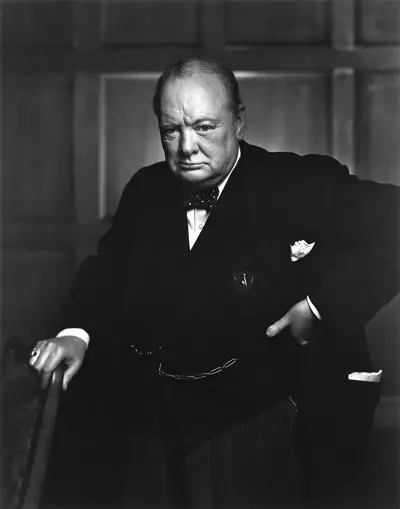
Sir Winston Leonard Spencer Churchill, KG, OM, CH, TD, DL, FRS, RA was the Prime Minister of the United Kingdom from 1940 to 1945, during the Second World War, and again from 1951 to 1955. Apart from two years between 1922 and 1924, Churchill was a Member of Parliament (MP) from 1900 to 1964 and represented a total of five constituencies. Ideologically an economic liberal and imperialist, he was for most of his career a member of the Conservative Party, as leader from 1940 to 1955. He was a member of the Liberal Party from 1904 to 1924. Churchill was also well known for his military career and as a historian, painter and writer, and among his many awards was the Nobel Prize in Literature.
