John C. Calhoun Quotes
In the policy of nations there are two extremes: one extreme, in which justice and moderation may sink in feebleness; another, in which the lofty spirit which ought to animate all nations, particularly free ones, may mount up to military violence. These extremes ought to be equally avoided; but of the two, I consider the first far more dangerous.
John C. Calhoun, 1782-1850, Vice President of the United States (Democrat, SC), U. S. Congressman & Senator (Democrat, SC), Speech, U. S. House of Representatives, January 31, 1816
Sourced by: Eigen's Political and Historical Quotations


Every major Western power and Japan were looking to control parts of China for their own mercantile advantage. The Emperor, her adopted son, had stated that under no circumstances would the Chinese fight, but Cixi issued this decree, in effect, overruling the Emperor—a remarkable occurrence.


This is a very important historical and political quotation. First, notice that the Secretary of State was criticizing the policies of his President, a refreshingly honest statement, but one which would never be made after the 1950s. The criticism was not even mild but very heavy. A political opponent could not be more negative. Next consider that while the Secretary of State and almost all the experienced diplomats thought the President foolishly wrong and naive about the practicality of self-determination, by the end of the 20th century, virtually every country in the world, capitalist, communist, secular or religious, wealthy or impoverished, all see self-determination is a basic right of all nations. The President was on the right side of history and all the professional diplomats on most nations were on the wrong side. However, Secretary of Lansing was right about one thing. The quest for self-determination has caused a fearful toll of human lives—not thousands as Lansing predicted but millions. He was also right about another aspect—namely that the unit of self-determination can be confusing and contentious. For example, the French Canadians of Quebec want a great deal of self determination and autonomy, but they do not want to give the same right of self-determination to the Mohawk Indians in Quebec who want to govern themselves. There is a continuous dispute in Turkey where the Kurds claim the right of self-determination within Turkey. Turkey has literally dozens of minority groups. Does self-determination mean that each can have its own nation within what is Turkey. And what about the Native Americans in the United States? Nonetheless, Wilson’s general principle is approved by all while the details are often contentious.


While it is true that thus far in human history war has been the only way, that does not necessarily mean that that is the only way. The establishment of free trade used to be only accomplished by force or arms or fear of such, but in modern times, common markets and trading zones are being created for economic and domestic desires for economic development. Even most non democratic countries have wanted to create a larger market for its goods and services and have joined larger organizations irrespective of military defeat and its fear. See {553984} for perspective and hope relating to this quotation.


His appeal was also in the name of concurring heads of state of Finland, Holland, Denmark, Norway, Luxemburg, and Sweden.


The plan was to have an American agent with a few marines make an alliance with a rival to the throne of Algiers and depose the existing ruler with American “special forces”.

The highest court in New York.
The highest court in New York.
While to Madison the principle that “war is better than tribute” was “settled policy”, there were many who disagreed. See {640867} as an example.


Greek invaders were marching on Istanbul
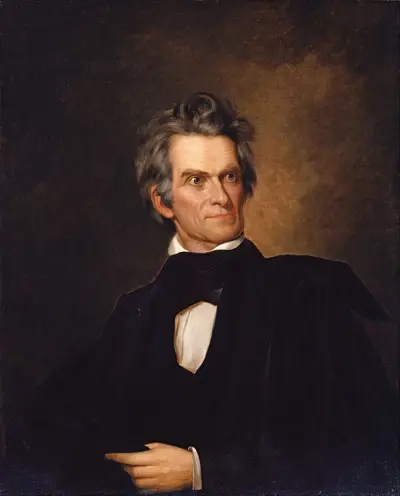
John Caldwell Calhoun was an American politician and political theorist from South Carolina who held many important positions including being the seventh vice president of the United States from 1825 to 1832, while adamantly defending slavery and protecting the interests of the white South when its residents were outnumbered by Northerners. He began his political career as a nationalist, modernizer, and proponent of a strong national government and protective tariffs. In the late 1820s, his views changed radically, and he became a leading proponent of states' rights, limited government, nullification, and opposition to high tariffs. He saw Northern acceptance of those policies as a condition of the South remaining in the Union. His beliefs and warnings heavily influenced the South's secession from the Union in 1860–1861.
