Bill Clinton Quotes
In the last years, the anti-government paradigm has led us into one blind alley after another.
The Republicans in the previous decades had gone so far to the right and were so opposed to anything the government might do, that they could not support anything that might be constructive for the country if it might look like the Government was capable of something positive. They accomplished almost nothing as a result, and the nation was gridlocked.
William Clinton, 42nd President of the United States (Democrat, AR), Presentation, New York City Historical Society, November 8, 2011
Sourced by: Eigen's Political and Historical Quotations


At the time, the Republicans held the House of Representatives, but not the Senate or the Presidency. By popular vote, even the House elections had the majority voting for the Democrats, but the gerrymandering gave the Republicans more seats. A minority of the minority Republicans were Tea Party Republicans—ultra conservatives who would not compromise but who intimidated other Republicans by threatening to run candidates against them in primary elections. The result was that the Tea Party Republicans—a minority of the minority could block almost any legislation and did. That Congress passed less legislation than any in American history including the “Do Nothing Congress” of the Truman era.


After Roosevelt, most eras of American politics more or less followed the pattern Roosevelt described herein as a “calamity”, with the anger becoming more or less intense. Jefferson thought that these were natural divisions of politics in all societies--{604810}. The thing that masked this for years was race and slavery. In Lincoln’s time there were liberals and conservatives in both parties if race were ignored. In Theodore Roosevelt’s era, he, Taft and others were generally liberal reformers, while a large number of Republicans were conservative supporters of the status quo. Some democrats were radical reformers like William Jennings Bryan while others were arch conservatives. Until 1964 and the Civil Rights Act there were many conservatives in the Democratic Party, but almost all switched to the Republican Party in anger. The Republican conservatives tended to drive the Republican liberals out of the party and for the last part of the 20th century Roosevelt’s “calamity” well described the American political scene, and the anger increased carrying partisan bitterness into the 21st century.

Reporting on public dissent following Abraham Lincoln's election.


The Tea Party Republican faction was opposed to government doing much of anything other than Defense and Foreign Policy. The regular Republicans saw a much more extensive and robust role of government though few did so to the same extent as Abraham Lincoln and the other founders of the Republican Party, and Theodore Roosevelt and Dwight D. Eisenhower the Republicans following in the Alexander Hamilton tradition.


This quotation is classic as it was the first of a series of attacks that have been made on presidents and other politicians by the economic ultra-rightists when the conservatives had disliked the politician’s economic policies. To criticize the ultra-rich and their corporations was promoting class warfare. And that criticism being made public certainly upset the confidence of the rich in the President. When the president pointed out how the average person feels about the rich, to them it was he who was responsible for the mistrust and hatred by talking about them—not them by what they were doing. This same attack has been made against every Democratic President that came thereafter, but it was first used against Republican Theodore Roosevelt. For many Liberals, the way they know that they are starting to succeed with economic reform is when they get attacked for fomenting class warfare.

His Republican Party had filibustered more bills in the Senate then had been done previously in all of the Senate History together. Congress passed fewer bills in his first two years than any other Congress in history.

Actually, there have been “paranoid” fear of opposition political viewpoints in America very often. In the early days of the Republic, the Federalists main concern was not England or other foreign enemies, but Jefferson’s Democratic Republicans. And those Jeffersonians were absolutely convinced that the greatest danger to America was the Federalists who would bring back a monarchy if they could. The Jacksonians triggered a similar polarization. The Civil War stemmed from this extreme. Even America’s most popular President, Franklin Delano Roosevelt, who was elected to 4 successive terms, was perceived as the major “enemy” of America along with his wife Eleanor and the other New Dealers.


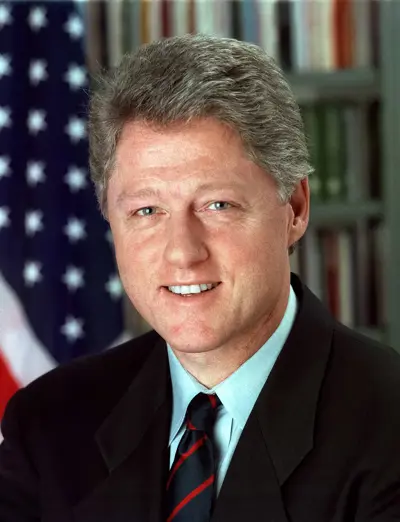
William Jefferson "Bill" Clinton is an American politician who was the 42nd President of the United States from 1993 to 2001. Clinton was previously Governor of Arkansas from 1979 to 1981 and 1983 to 1992, and the Arkansas Attorney General from 1977 to 1979. Clinton was born William Jefferson Blythe III – he changed to his stepfather's name at age 15.
