John Bercow Quotes
If you asked me if I'd rather be Speaker or a very senior minister, I'd say Speaker.
Aitkenhead, Decca. "John Bercow: 'I've never been much given to little social cliques.'" The Guardian, 24 Feb. 2012.


The Supreme Court had decided to hear an important case on gun rights. Cheney discovered that Solicitor General, the Administration’s chief lawyer before the Supreme Court, Paul Clement planned to file a brief that was very different from Cheney’s own personal views. In protest, he signed his name to a much stronger brief filed by 55 pro-gun senators and 250 members of the House of Representatives. The President’s Chief of Staff called Cheney on the carpet for doing something that was unforgivable—the Vice President had publicly criticized the position that the President’s (and the Vice President’s) chief lawyer was taking. This was Cheney’s excuse—ie that he was not protesting as the Vice President but as President of the Senate, the only other Constitutional Role of the Vice President. Bolton let the vice president know that if he ever tried something like this again, he would be frozen out of most government activities. See {633772} . In Bush’s second term Cheney had less and less influence, in part because of his unethical behavior like this.


President Carter had just held Israeli Prime Minister Menachem Begin and Egyptian President Anwar Sadat at Camp David for thirteen days, until they reached an agreement on governing Sinai, the West Bank, and the Gaza Strip. Califano wrote this to Carter in his note the following day.

The speaker, allegedly drunk, had crashed his car into two others in Georgetown. At the time, the Congress controlled such things as salaries of Washington civil servants.


To Mises, “interventionism” is any government action that affects business and businessmen and women. In a large complex society, virtually every government action will benefit some more than others while harming some more than others. There are almost always winners and losers as a result of every government action. Most political philosophers see justice and fairness in benefitting the majority of people most of the time. However Mises and others observe that in a large complex society, in an absolute sense, politics and government can never be fair and just to all.


Periodically in American history, there has been a struggle between the Executive Branch and the Senate for dominance. The Senate’s power is negative however. It can block things, but cannot directly make them happen. The President can do both.

The assumption of one supreme authority being necessary for a state, has been the most common assumption in almost all cultures and times before the American Revolution. What is amazing is that the Founding Fathers rejected this notion in favor of our complex system of checks and balances restrained by a Constitution which no society had ever tried before. England in contrast as it became more democratic, simply shifted the supreme, uncontrollable entity from the King to the Parliament which it is even today. Parliament can do virtually anything unrestrained by anything except their judgment and tradition.
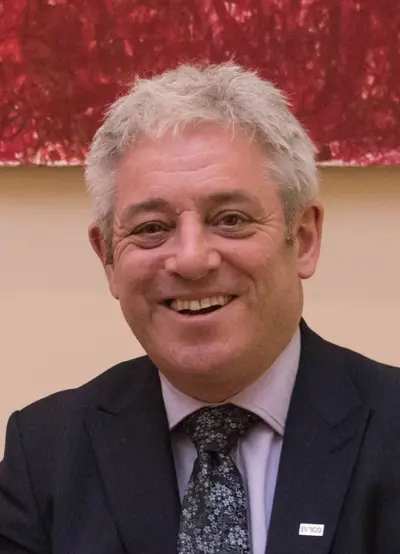
John Simon Bercow PC is a British politician who served as Speaker of the House of Commons from 2009 to 2019, and as Member of Parliament (MP) for Buckingham between 1997 and 2019. He was the first MP who was elected Speaker without previously serving as a Deputy Speaker since Selwyn Lloyd in 1971. Prior to his election as Speaker, he was a Conservative MP.
