King James I Quotes
If you aim at a Scottish presbytery, it agreeth as well with monarchy, as God and the devil. ... No bishop, no King! I will make them conform themselves, or else I will harry them out of the land, or else do worse.
Barlow, William. The Summe and Substance of the Conference, which, it pleased his Excellent Majestie to have with the Lords, Bishops, and other of his Clergie... at Hampton Court. John Windet, 1604, pp. 81-82.


Although James’ mother, Mary Queen of Scots had been a Catholic, James was a fervent Protestant. However, he found the separation of the State from authority over the church and the Presbyterian approach not to his liking. Also, the early tradition of the Presbyterian preachers scolding the monarch, especially his mother, was uncomfortable for James.


Some politicians then and later were not as religious as the leading clerics would prefer. The quotation shows that priests commonly married at that time even though the church had forbidden it.

The Vatican & the Chinese Communist Government had been at odds for years with much of the Chinese church going underground. Fr. Jin had been jailed for a decade. Then the government allowed him and the Catholic Church and operate openly, but there were still Vatican conflicts over numerous issues including the right of the Government to approve senior appointments of church officials—a privilege the church claimed exclusively. The Vatican ordered Jin not to cooperate and especially not to reopen the national theological seminary which the government had ordered closed. There had been no training for Chinese priests and Jin wanted to reopen the national theological seminary but the Vatican refused cooperation waiting for the government to capitulate to the Vatican’s various demands. Fr. Jin defied the Vatican & reopened the seminary. Without officially admitting their failed tactics, the Vatican let the discipline issue against Jin drop & the national theological seminary thrived.

Stephani had written a legal analysis of the 1555 “Peace of Augsburg” and used the phrase of the quotation to describe the most basic and important legal agreement. It was that the recognized religion of a nation would be determined by the religion of the king or other ruler. Prior, Protestant and Catholic nations were constantly warring with each other and supporting insurrections in another country of its co-religionists and often warring with the other country where some towns were mostly Protestant and others, mostly Catholic. The treaty which dealt with Europe initially allowed Catholic citizens of a nation ruled by a Protestant to emigrate to a Catholic nation and the reverse. Those who chose to remain, would therefore be a minority of the country where their king was of a different faith. This principle is one of the reasons that English law requires the King or Queen to be the Head of the Church of England. In effect the Protestants controlling England at the time guaranteed that the sovereign was a Protestant and could not have a Catholic spouse in line for the throne. This then guaranteed that England would remain Protestant since the ruler was Protestant. Other European nations, Protestant and Catholic, had similar schemes and many still have them to this day.


James was a Catholic King and did not like Protestants but positively detested Puritans. He made good his and “harried them out of the land” much to the benefit of the American colonies to which they immigrated and the detriment of England. Many of the immigrants to America came for the religious freedom, but in the early days, no sooner did they arrive and become the majority, than they began to discriminate against other religions.


England had gone through a bloody Civil War with the Parliament on one side and the King on the other. The King lost and was beheaded later that year. See {597353}.


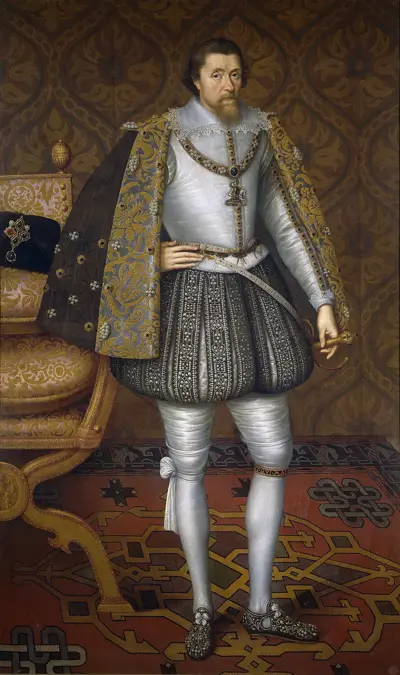
James VI and I was King of Scotland as James VI from 24 July 1567 and King of England and Ireland as James I from the union of the Scottish and English crowns on 24 March 1603 until his death in 1625. The kingdoms of Scotland and England were individual sovereign states, with their own parliaments, judiciaries, and laws, though both were ruled by James in personal union.
