HENRY II
Four of his Knights took him literally and murdered the Archbishop in his cathedral.
And let the sheriffs who have arrested them bring them before the justice without any other summons.
This assize is generally considered to be the first written specification of due process in English Common Law.
This required much of the population to maintain and bear arms. Another part of the law required the arms-bearers to be at the service of the king and as such was the king's militia.
Prior to that there was no redress any layperson had except to the religious courts. Churches throughout the Christian world excoriated this early separation between church and state, and giving civil courts jurisdiction over the churches on non-religious matters. Thomas Beckett led the English opposition to the enforcement.
This idea was incorporated in the FBI's "Most Wanted" list.
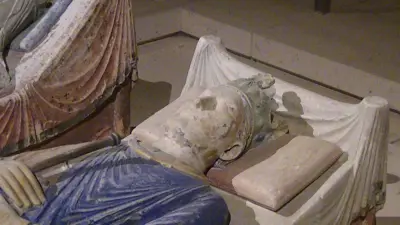
Henry II, also known as Henry Curtmantle (French: Court-manteau), Henry FitzEmpress or Henry Plantagenet, was King of England from 1154 until his death in 1189. He was the first king of the House of Plantagenet. King Louis VII of France made him Duke of Normandy in 1150. Henry became Count of Anjou and Maine upon the death of his father, Count Geoffrey V, in 1151. His marriage in 1152 to Eleanor of Aquitaine, whose marriage to Louis VII had recently been annulled, made him Duke of Aquitaine. He became Count of Nantes by treaty in 1185. Before he was 40 he controlled England, large parts of Wales, the eastern half of Ireland and the western half of France; an area that was later called the Angevin Empire. At various times, Henry also partially controlled Scotland, Wales and the Duchy of Brittany.
