Theodore Roosevelt Quotes
I wish to see the Hague Court greatly increased in power and permanency
It is a huge surprise for modern Republicans to discover that the great Republican President, Theodore Roosevelt, advocated strengthening the power of the World Court. 21st century Most Republicans consider this court and other international tribunals to be infringements on American sovereignty, and politicians who agree with Roosevelt as traitors.
Theodore Roosevelt, 1858-1919, 26th President of the United States (Republican, NY), Statement to Elihu Root, his Secretary of State, regarding the International Court of Justice, 1907, Quoted in Manley O. Hudson, “The United States and the New International Court”, Foreign Affairs, December 1922
Sourced by: Eigen's Political and Historical Quotations


The Senate refused to ratify.

This quotation has special historical significance in American political history. Conservative President Warren G. Harding first suggested that the United States join and recognize the authority of the International Court. Then Herbert Hoover, a Republican icon after his term of office, in his Inaugural Address, advocated the Court. However, many of his own party and some Democrats were opposed to the U. S. recognizing any international court. So Hoover bucked the leadership of his own party. The FDR administration in 1935 signed the protocol, but it was never ratified by the two thirds of the Senate that was needed to become American law. In the beginning of the 21st century, the Republican was rabidly in opposition to any International or world court even though Hoover and Harding were all for it.


Ironically, by the 21st century, the Republican Party had moved so far to the right that it rejected the earlier Republican position on the International Courts and opposed American participation. Many Republicans of that era are amazed that Republicans endorsed American participation in an International Court ever.


Ingersoll was considered to be the greatest orator and political thinker of his day, but his overt atheistic views curtailed his elected political career. Ever since the founding of our republic, the concept of a World Court has been polarizing. In the early days of the nation, many Americans did not trust the more powerful European states to be fair. When we became the most powerful state, many of us didn’t trust the weaker nations to be fair and maintain our standards of law.

There is no court structure that handles International law disputes. There are some international bodies that hear some types of international law disputes, but no general mechanism. The procedures of these few bodies are very complex and arcane. But worse, there is no body with any power that can enforce any decision that may be reached. Enforcement depends on the good will of the nations involved or the pressure that can be brought to bear by other counties.


The minister had refused to be pressured by the George W. Bush Administration to sign an agreement with the US agreeing never to turn over an American or a foreign national working for America to the International Criminal Court (ICC). Even if a Peruvian or other non-American were working for an American Agency as an informant, agent, or other role, the country could not respect the treaty obligations that they had already made with regard to the ICC. Peru was “punished” losing $4 million aid. Nations were so “punished” while the State Department was spending huge sums to remedy negative opinion that so many nations had developed for the US during the George W. Bush administration. See {585493},65901 & {585496}, for more quotations on this. The US did not join the ICC Treaty as in some countries political considerations and different ethical values have labeled some American legitimate behavior as criminal and have attempted to hold individuals responsible for carrying out lawful orders. So many foreigners could understand the United States not wanting to deny Americans and others in the United States the protection of the United States Constitution, there was ire at the US pressuring others to boycott the ICC and break their existing treaties.

The United States Senate must ratify all treaties before they can become effective. The Senate has been very reluctant to ratify treaties where the U. S. government or any of its citizens could come under the jurisdiction of any legal entity which did not abide by all the rights citizens are guaranteed by the U. S. Constitution. As a result, we do not recognize the World Court and the Treaty of Rome for example. The latter is the one that gives the World Court jurisdiction over a high level official who commits war crimes even in his own country. The result is that many dictators who do not want to be constrained by international law, do not sign the treaty fending off any pressure to do so by pointing to the United States. But Rothkopf and others who agree with him have not yet been able to come up with a mechanism that will assure American Constitutional rights to Americans who might be involved with the World Court and allow the court to punish the dictators who abuse their own population. The French would like their laws and constitution to control. The Russians, theirs. The Chinese, theirs. Every American public official takes an oath to defend The Constitution. That is their primary duty. Foreign policy and punishing international war criminals must take a lower priority.


The Arab World is made up of many small states who usually vote as a bloc. In addition, most of the other Islamic nations vote with their Arab co-religionists. Since its founding Israel has developed rapidly while the Arab nations have not and some have regressed. Their governments are embarrassed by their lack of progress and blame Israel to mollify their citizens.
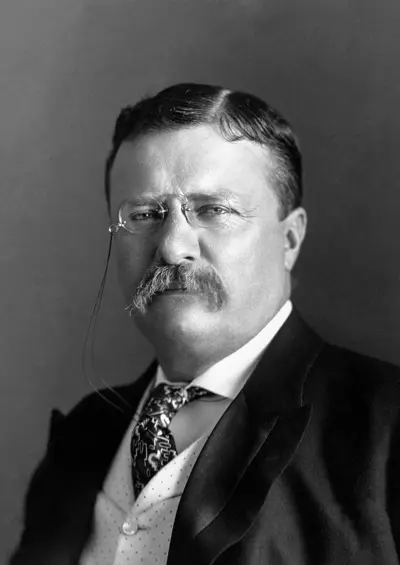
Theodore Roosevelt Jr., often referred to as Teddy or his initials T. R., was an American statesman, conservationist, naturalist, historian, and writer, who served as the 26th president of the United States from 1901 to 1909. He previously served as 33rd governor of New York from 1899 to 1900 and the 25th vice president of the United States from March to September 1901. Roosevelt emerged as a leader of the Republican Party and became a driving force for anti-trust and Progressive policies.
