Christopher Columbus Quotes
I ought to be judged as a captain who set out from Spain to the Indies to conquer many warlike peoples of very contrary creed and customs, where by divine will, I have placed under the sovereignty of the King and Queen, Our Lords, another world, by which Spain, which was once called poor, is now the most rich.
Christopher Columbus, 1451-1506, Italian Explorer, Letter to Dona Juana de la Torre, 1500
Sourced by: Eigen's Political and Historical Quotations


Also known as Ferdinand II or Aragon. We have provided an extensive quotation from the letter. In retrospect, it is incredulous today that Ferdinand would make such demands or even would believe that the Indians would understand the terms or their consequences, the threats. Even the promises that are made were ignored because of the Indian’s “intransigence.”


Felipe, capitalizing on the death of the Portuguese King, declared in 1580 his intention of uniting the Iberian peninsula under his rule.

This resolution today would be funny if it did not have such serious implications—of feeling not only justified in taking all Indian land but actually convincing themselves that they were following the will of God. Most countries have gone through similar rationalizations of immorality and aggression but rarely with the self-serving logic so nakedly displayed.

While he fairly described the Spanish intentions, the reality which was not known at the time, was that most of the deaths in South America were caused by disease brought by the Spanish for which Europeans had some immunities and the natives of the New Word, none.
Juan Lopez de Vivero. This document was a written declaration of sovereignty and war, read by Spanish military forces to assert their sovereignty (a dominating control ) over the Americas and their peoples. He issued it on “behalf of the King, Don Fernando, and of Doña Juana I, his daughter, Queen of Castille. and León”. It was read to the native peoples of the New World in Spanish which they did not understand and then were held to it on penalty of death thereafter. It was the legal and philosophical foundation for the worst example of colonial abuse in history.


This particular quotation is very important. Khomeini was probably the most influential Muslim in the 20th Century. The fact that he wrote this in 1942—before there was an Israel as an enemy—shows how deep seated the requirement for world conquest is. To the Nazi’s world conquest was a justifiable goal. To Khomeini and his many followers, it is a religious obligation and duty and thus is every more dangerous. Extreme anti Muslims justify the attempted expulsion of Muslim immigrants on the grounds that they are a fifth column whose loyalty is and will be to the religion which will attempt to conquer their country. It gives Islamaphobia a veneer of respectability.
Conceptually this is one of the most absurd documents in history, written by a European King to the native Indians of the new world, virtually all of whom were illiterate, knew nothing of Christianity or of European politics.


The contrast between the Christian piety memorializing the taking of the city and then as soon as the ceremonies were complete the pillaging and plundering, is dramatic. Religion controlled and permeated the military thoroughly at the time—even to the organization of un-Christian acts like plunder and murder of civilians.
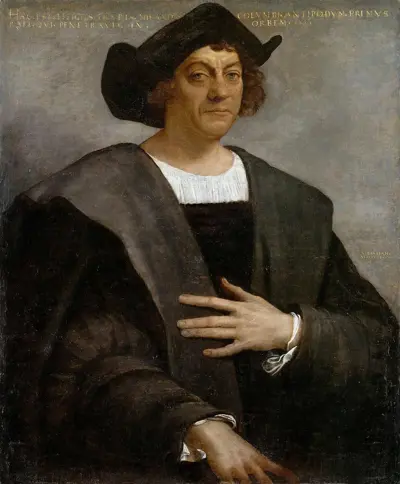
Christopher Columbus was an Italian explorer and navigator who completed four voyages across the Atlantic Ocean, opening the way for the widespread European exploration and colonization of the Americas. His expeditions, sponsored by the Catholic Monarchs of Spain, were the first European contact with the Caribbean, Central America, and South America.
